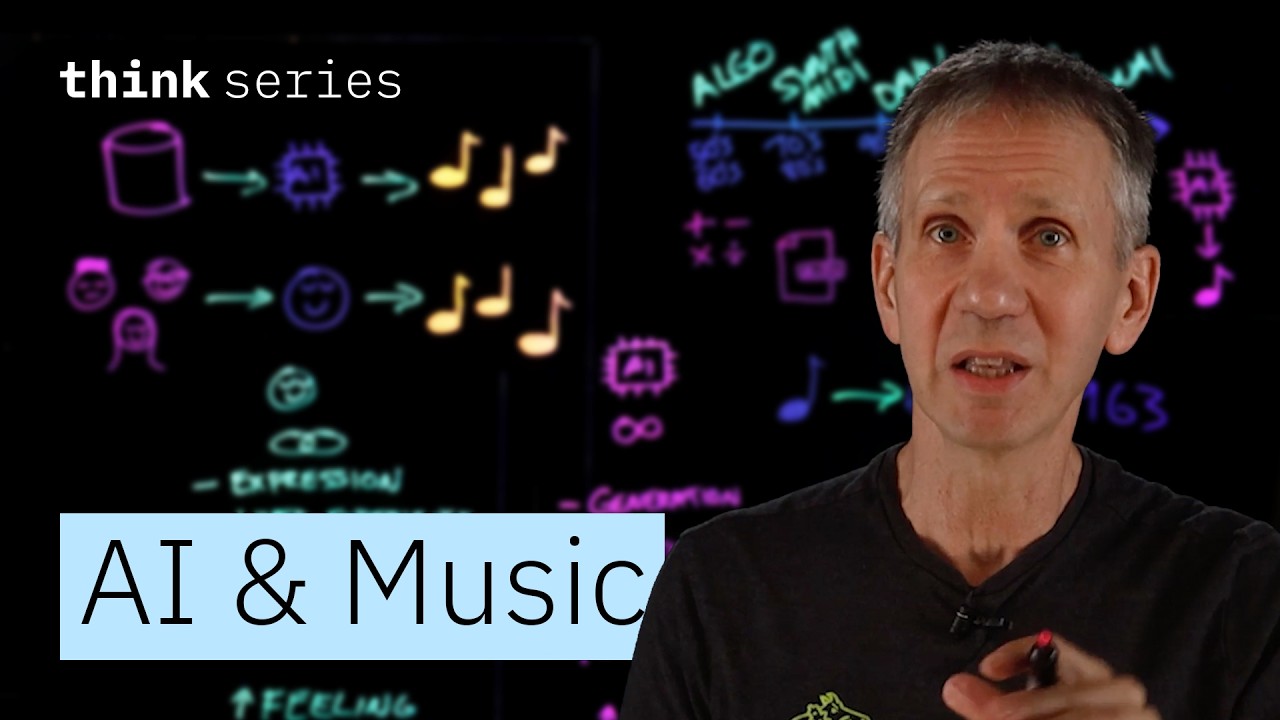
AI & Music: How AI Is Changing Music Creation & Creativity
AI is fundamentally changing music creation by providing unprecedented tools for composition, arrangement, and performance. Rather than viewing AI as a replacement for human musicians, the speaker argues that it represents the next major technological instrument, enabling new collaborative models. AI excels at scale, variation, and repetition (e.g., generating full arrangements, mastering, or writing lyrics in any style), while human artists retain the unique ability to provide emotional connection, lived experience, and spontaneous live performance energy.
Key takeaways
-
The Nature of Musical Originality
2:03
Music has always been built on recombination and variation (e.g., the 12-bar blues progression). AI did not invent this concept; it only changed the speed, scale, and opacity of recombination.
-
Historical Evolution of Music Tech
4:10
Music technology has progressed from 50s algorithmic compositions (using mainframes and mathematical rules) to the introduction of MIDI (Musical Instrument Digital Interface) in the 70s/80s, and finally to modern deep learning and generative AI in the 2020s.
-
AI's Role in Collaboration
9:30
The most effective approach is a hybrid model: AI can write the initial composition or provide suggestions, while the human handles the revisions, performance, and emotional direction. AI acts as a 'brainstorming partner' or 'assistant.'
-
AI's Core Strengths vs. Human Strengths
12:50
AI's strength is scale, infinite patience, and variation (e.g., auto-mastering, modulation). Human strength lies in connection, expression, and the unique energy of live performance.