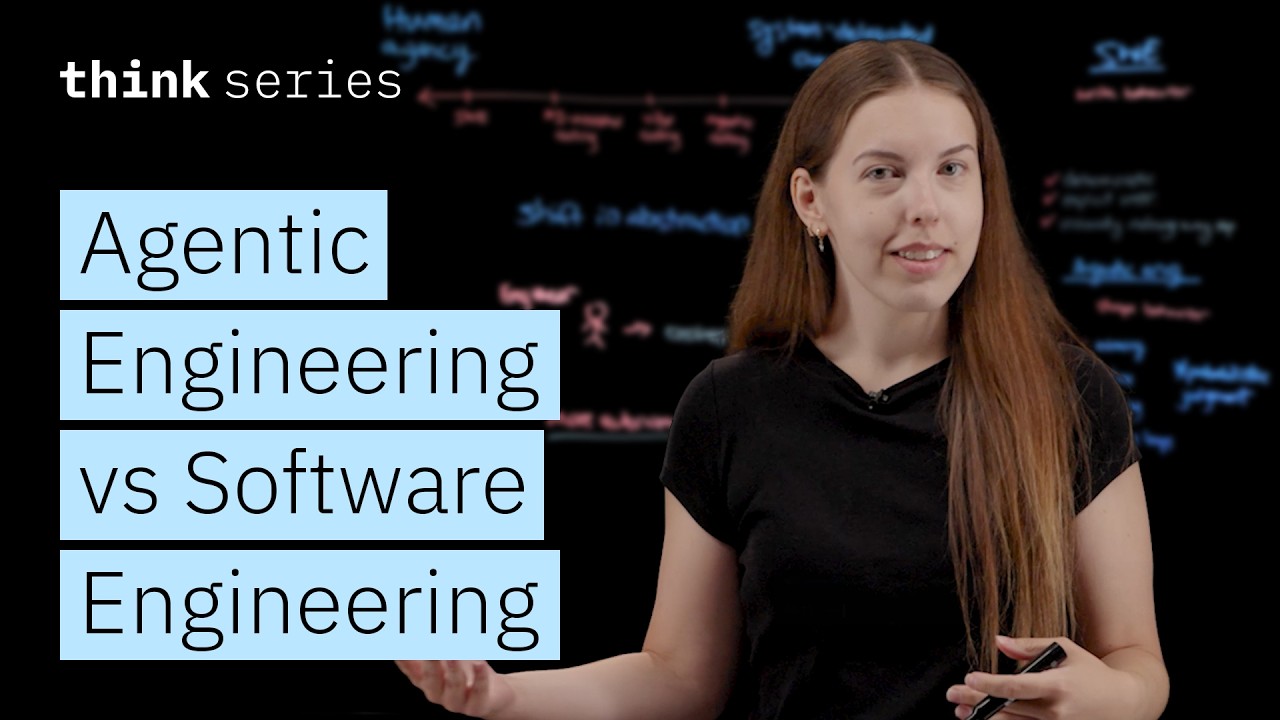
Agentic Engineering vs Software Engineering: Beyond Vibe Coding
Software engineering is undergoing a fundamental shift from writing explicit, deterministic instructions to defining high-level goals and orchestrating autonomous AI agents. Agentic Engineering treats AI systems as collaborators capable of multi-step workflows, requiring the human developer's role to evolve into that of an architect who supervises, constrains, and validates probabilistic outputs rather than manually executing every task.
Key takeaways
-
The Shift in Effort
Traditional software engineering requires writing explicit instructions (deterministic logic). Agentic Engineering allows developers to define goals, while AI agents handle the execution, changing where the core engineering effort is applied.
-
Defining Agentic Engineering
3:42
Agentic refers to an organization of agents that write code, while the human developer maintains a 'human in the loop' to oversee and validate the output as the multi-agent system iterates through subtasks.
-
The Coding Spectrum
5:01
Coding methods exist on a spectrum based on human agency: Traditional SE (full control) $ ightarrow$ AI-assisted coding (snippets/refactoring) $ ightarrow$ Vibe coding (natural language intent) $ ightarrow$ Agentic coding (autonomous planning/execution) $ ightarrow$ Agentic engineering (designing environments for autonomous systems).
-
Increased Value of Oversight
8:44
As agentic systems become more autonomous, the value of human oversight increases significantly. Engineers are now responsible not only for writing code but also for ensuring reliability across probabilistic workflows.