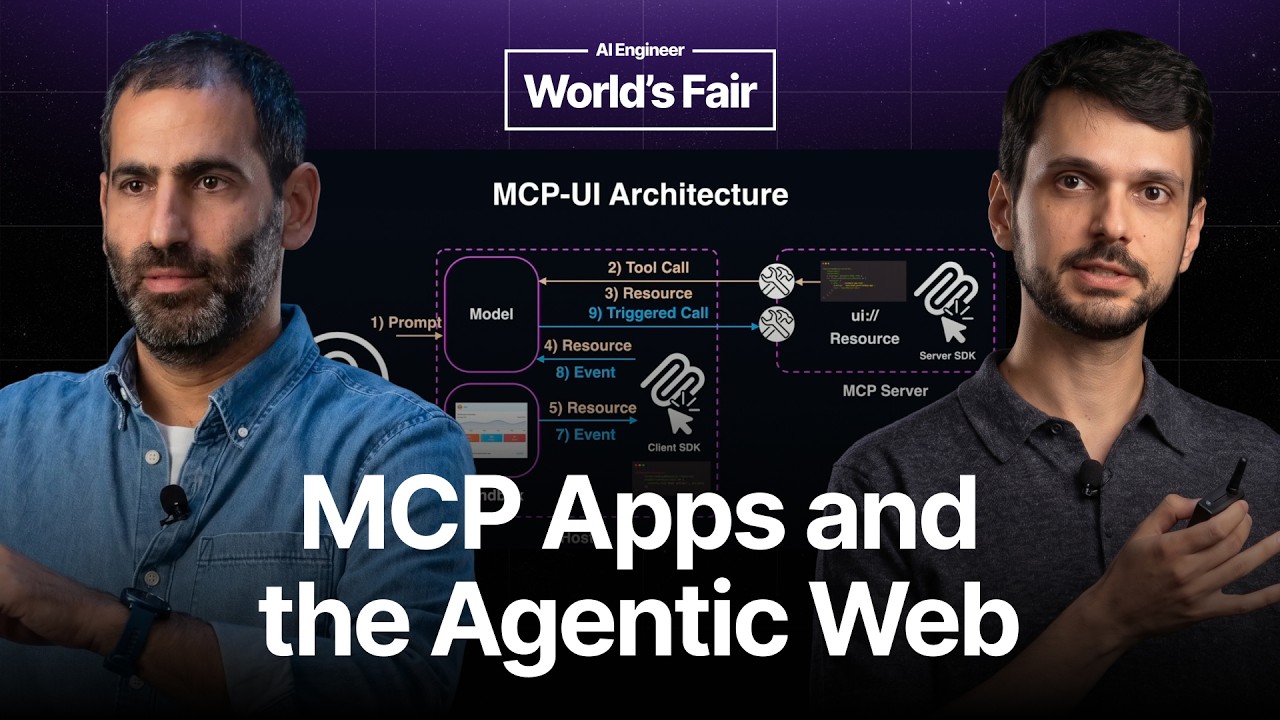
MCP Apps: Extending the Frontier — Ido Salomon & Liad Yosef
MCP Apps introduces a standardized protocol for embedding rich, interactive user interfaces directly into AI chat assistants, moving beyond text-only responses. This system allows services (like Shopify or PostHog) to maintain their brand identity and full UX within the agentic loop. By standardizing how tool calls link to rendered web components, MCP Apps ensures that interactions flow back through the host, giving the host control over the user journey. The goal is to enable a 'write once, run anywhere' model for applications across major AI platforms (ChatGPT, Claude, etc.), fundamentally changing how the web is consumed in the era of personal assistants.
Key takeaways
-
The Problem with Text-Only Chat
0:24
Textual responses are suboptimal for conveying complex information or maintaining brand identity. Companies want their full UX to be visible and interactive within the chat interface, rather than being reduced to a textual database.
-
MCP Apps Protocol
1:46
MCP Apps is an open protocol that allows services to send their UI directly into the chat. This enables not only visualization but also full interactivity, allowing users to act on the displayed content (e.g., favoriting a song).
-
Interactive Flow Control
3:30
When a user interacts with an embedded app component (like clicking a button), MCP Apps standardizes this flow by sending a message back to the host, which maintains control and decides whether to execute a tool call on behalf of the user.
-
The Agentic Web Vision
10:53
MCP Apps envisions a future where services are broken down into 'atoms' of UI that can be composed by personal assistants, allowing users to complete complex tasks without leaving the chat environment.