Why Are We Still Governing AI Agents Like Software? - Tim Tyler, Gravitee
Summary
The presentation introduces the Agent Accountability Framework, arguing that AI agents should not be governed merely as software applications. Instead, they must be treated as a 'digital workforce,' requiring governance across three stages: Assignment, Alignment, and Administration. This framework mandates establishing a unique identity, defining clear roles and scopes, and implementing continuous oversight and recourse mechanisms to ensure agents operate within defined boundaries.
Key takeaways
-
Assignment: Establishing Identity and Accountability
3:47
Agents require a unique ID in a known, shared registry (single point of truth). Furthermore, every agent must be part of a team and assigned a named human sponsor who holds ultimate accountability for the agent's actions, costs, and failures.
-
Alignment: Defining Role, Mission, and Authority
10:00
Agents must have a defined role (purpose and responsibilities) and a scope of authority. Authority must adhere to the 'lowest scope' principle, meaning access is strictly limited to what is necessary. The framework distinguishes between the static 'onboarding' scope and the dynamic 'runtime' mission.
-
Administration: Oversight and Recourse
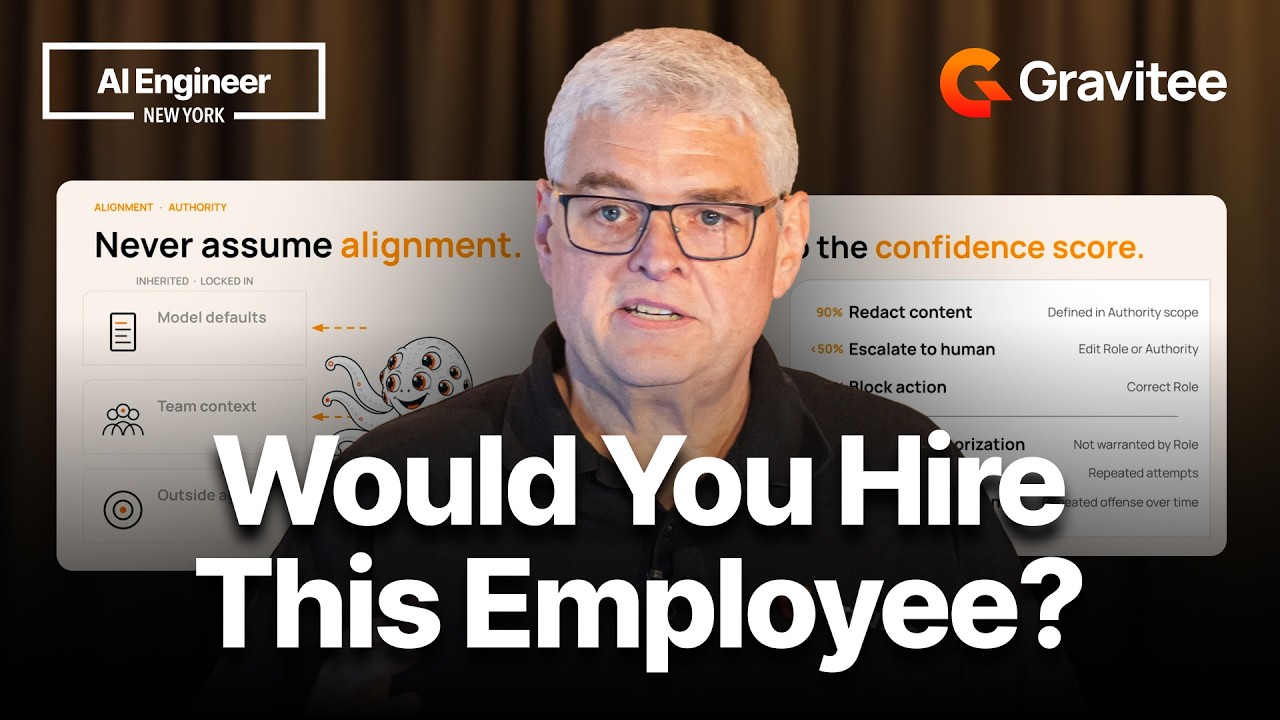
Governance requires continuous oversight, using 'oversight scorecards' rather than single metrics. This involves monitoring the agent's behavior (staying within scoped authority) and its success (achieving defined roles). Recourse mechanisms must be deterministic, allowing for escalating actions (e.g., content redaction, human escalation, or suspension) when confidence levels drop or boundaries are crossed.
Technical details
-
Agent Identity and Registry
277s
Requires a unique ID that is logged in a centralized, shared registry to establish a single point of truth for the agent's existence and actions.
-
Scope and Authority Control
737s
Authority must be restricted to the lowest scope possible. The lineage of authority dictates that an agent's scope never grows beyond what its sponsor has been granted. The framework suggests using deterministic rules (like FGA policies) to define boundaries.
-
Oversight and Monitoring
Oversight is managed via a 'scorecard' approach, evaluating both adherence to authority (deterministic rules) and success against the role (probabilistic intents). Guardian agents are recommended for applying these checks at machine speed.
-
Recourse Mechanisms
Recourse must be structured to turn probabilistic judgments into deterministic actions. Example actions include content redaction, mandatory human-in-the-loop escalation (if confidence is low), or full suspension of the agent's operation.
Mentioned resources
Channel & topics
Watch on YouTube · Back to latest
This independent, AI-assisted summary is provided for commentary and informational purposes. It may contain errors or omit important context. Please watch the original video for the creator's complete presentation. Video, thumbnail, and related copyrights belong to their respective owners.