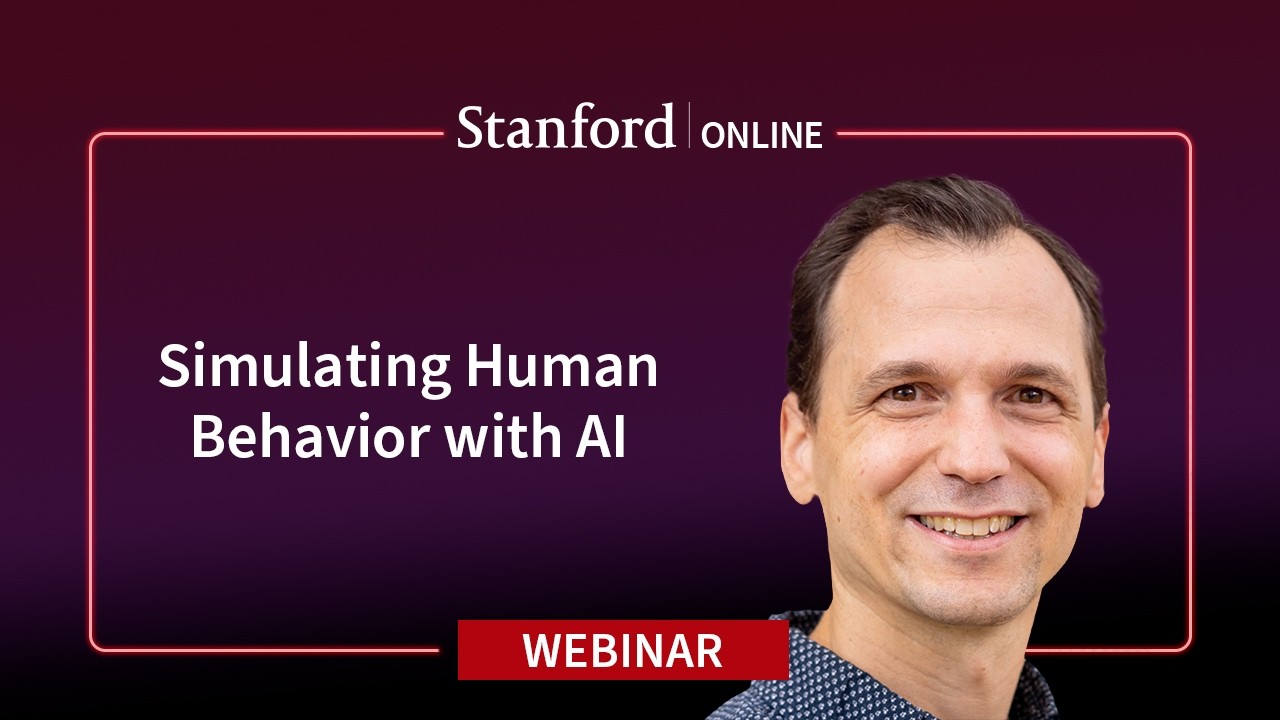
Webinar: AI Agent Simulation of Human Behavior with Michael Bernstein
Summary
Professor Michael Bernstein discusses the frontier of AI agents designed to simulate human behavior, moving beyond traditional, rigid agent-based models. By leveraging Large Language Models (LLMs) and advanced techniques like Retrieval Augmented Generation (RAG), researchers can create 'digital twins' of individuals and entire communities. These simulations allow for powerful 'what-if' scenario planning—predicting how customers or organizations might react to policy changes or product launches—thereby helping to mitigate risks before real-world deployment. The accuracy of these agents is highly dependent on the richness and relevance of the initial qualitative data provided.
Key takeaways
-
AI Agents for 'What-If' Scenario Planning
5:30
AI simulations allow organizations to model human reactions to interventions (e.g., policy changes, new products) when real-world data is incomplete, enabling better decision-making and risk mitigation.
-
Advanced Agent Architecture Requires Memory, Reflection, and Planning
19:10
To achieve believable behavior, agents must be equipped with a 'memory stream' (log of observations), utilize RAG to prioritize relevant memories, and undergo regular 'reflection' to develop higher-level goals and dispositions.
-
Accuracy is Enhanced by Rich Qualitative Data
27:30
Using extensive qualitative data (like 2-hour interviews) to build a 'digital twin' agent significantly improves accuracy. Simulations can achieve high replication ratios (e.g., 85% on the general social survey) compared to simple demographic or persona models.
-
Simulation is Best Used for Possibility and Qualitative Outcomes
38:20
While multi-agent simulations are ambitious, the highest reliability is found at the 'possibility' (what might happen) and 'qualitative' (attitudes) rungs, as quantitative outcomes (e.g., market research surveys) are prone to significant error.
Technical details
-
Generative Agents and LLMs
700s
The current frontier uses LLMs (e.g., ChatGPT, Claude, Llama, DeepSeek) trained on vast human behavior data and social media to prompt agents to take on diverse personas and simulate complex interactions.
-
Memory Management (RAG)
1150s
Agents require a 'memory stream' (a log of observations). To prevent context window overload, Retrieval Augmented Generation (RAG) is used to preferentially retrieve memories that are recent, important, and relevant to the current situation.
-
Agent Behavior Modeling
1150s
Believable behavior is achieved through three mechanisms: 1) Memory (RAG), 2) Reflection (asking the agent to produce higher-level conclusions about its memories), and 3) Planning (iteratively planning the day, hour, and minute).
-
Simulation Validation
1650s
The most accurate method involves using rich qualitative data (like full interviews) to create a 'digital twin' agent, which is then tested against standardized surveys and experiments.
Mentioned resources
Channel & topics
Watch on YouTube · Back to latest
This independent, AI-assisted summary is provided for commentary and informational purposes. It may contain errors or omit important context. Please watch the original video for the creator's complete presentation. Video, thumbnail, and related copyrights belong to their respective owners.