The 6 Pillars of an Agentic Harness for Production — Varun Krovvidi, Resolve AI
Summary
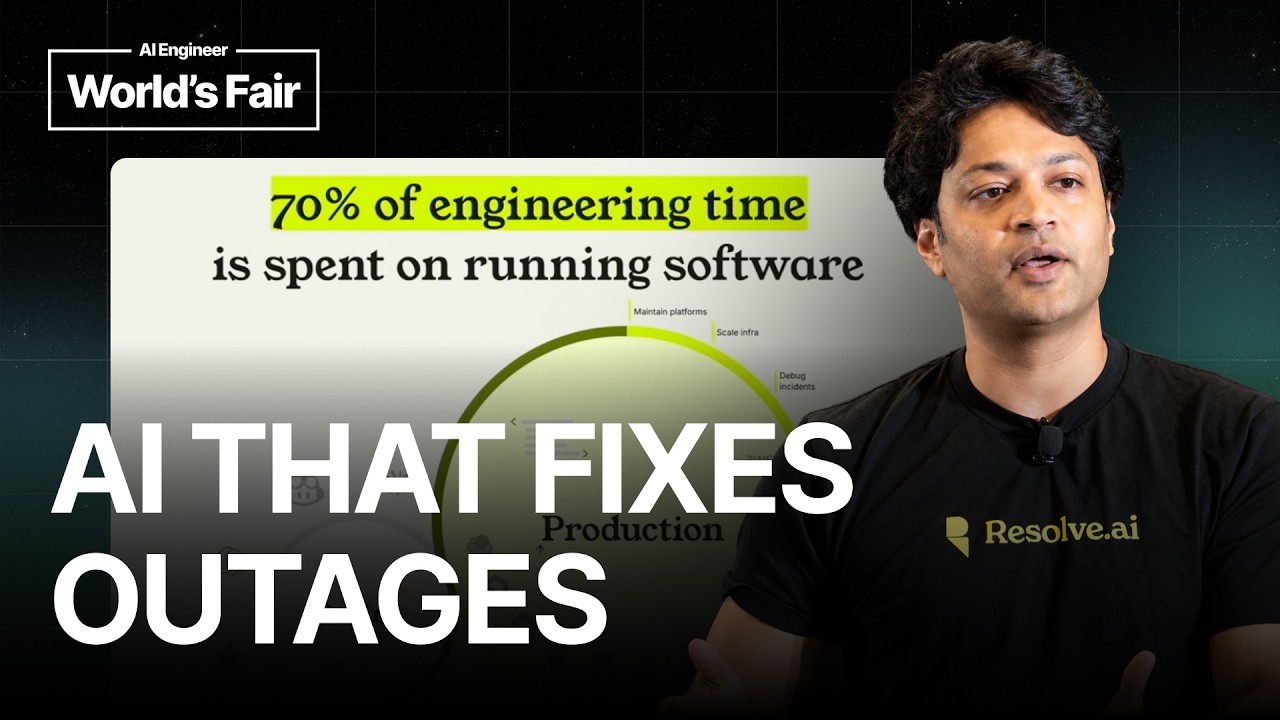
While AI excels at generating modular, single-domain code, the majority of engineering time (70%) is spent on the complex, multi-domain tasks of running and fixing production systems. The speaker outlines that scaling AI for production requires moving beyond simple model calls and implementing a robust 'agentic harness.' This harness must incorporate six critical pillars—Model Orchestration, Context Engineering, Causal Reasoning, Governed Actions, Learning Systems, and Evals—to handle real-world complexity, prevent hallucination, and ensure reliable root cause analysis.
Key takeaways
-
The Shift from Code Generation to Production Operations
4:53
Code is self-documenting, modular, and single-domain, making it easy for AI. However, production systems require managing multiple domains (code, infrastructure, telemetry, teams), which is fundamentally harder for AI to solve.
-
The Failure Modes of Production Agents
12:17
As AI scales, common failure modes include anchoring bias, the model treadmill (needing continuous model updates), context window issues (over- or under-exploration), lack of causal reasoning, missing guardrails, and failure to learn across investigations.
-
The Six Pillars of an Agentic Harness
19:12
A robust system requires: 1) Model Orchestration (matching the best model for the task); 2) Context Engineering (defining the precise amount of context needed); 3) Causal Reasoning (establishing a causal chain of evidence); 4) Governed Actions (defining least-privilege guardrails); 5) Learning Systems; and 6) Evals (systematic evaluation across multiple levels).
Technical details
-
Agent Architecture
623s
Resolve AI utilizes three agent types: On-call agents (for daily fixes), Incident agents (for driving complex root cause analysis), and Ambient background agents (for monitoring/analysis).
-
Causal Reasoning
AI systems must be designed to provide a causal chain of evidence (like a detective) rather than just a coherent answer, especially when diagnosing production incidents.
-
Model Orchestration
1242s
This involves two layers: keeping up with the 'model treadmill' (new models) and matching the best model for the specific task (e.g., Gemini for image reasoning, OpenAI for deterministic steps).
-
Context Engineering
It is not just about large context windows. It requires combining techniques (e.g., Graph RAG) and defining precise tool calls (for logs, metrics, dashboards) to prevent token waste and ensure focus.
Mentioned resources
Channel & topics
Watch on YouTube · Back to latest
This independent, AI-assisted summary is provided for commentary and informational purposes. It may contain errors or omit important context. Please watch the original video for the creator's complete presentation. Video, thumbnail, and related copyrights belong to their respective owners.