Stanford EE292R AI and Data for Science | Autumn 2026 | Models of Computation in the Retina
Summary
This lecture explores computational models of computation in the early visual system, focusing on the retina and visual cortex. The speaker details the evolution of modeling approaches, moving from simple linear models to complex, interpretable deep learning architectures like CNNs. A core theme is the necessity of mechanistic interpretability—using computational models to generate testable hypotheses about how biological neural circuits function, particularly concerning complex phenomena like motion detection and predictive coding. The research demonstrates that models trained on naturalistic stimuli can capture sophisticated biological features, providing a framework for understanding both biological and artificial neural networks.
Key takeaways
-
Mechanistic Interpretability in Neuroscience
2:00
Computational models are crucial for understanding biological systems, allowing researchers to move beyond mere correlation to formulate testable theories about how neural circuits perform functions (e.g., motion detection).
-
Model Complexity and Interpretability
5:40
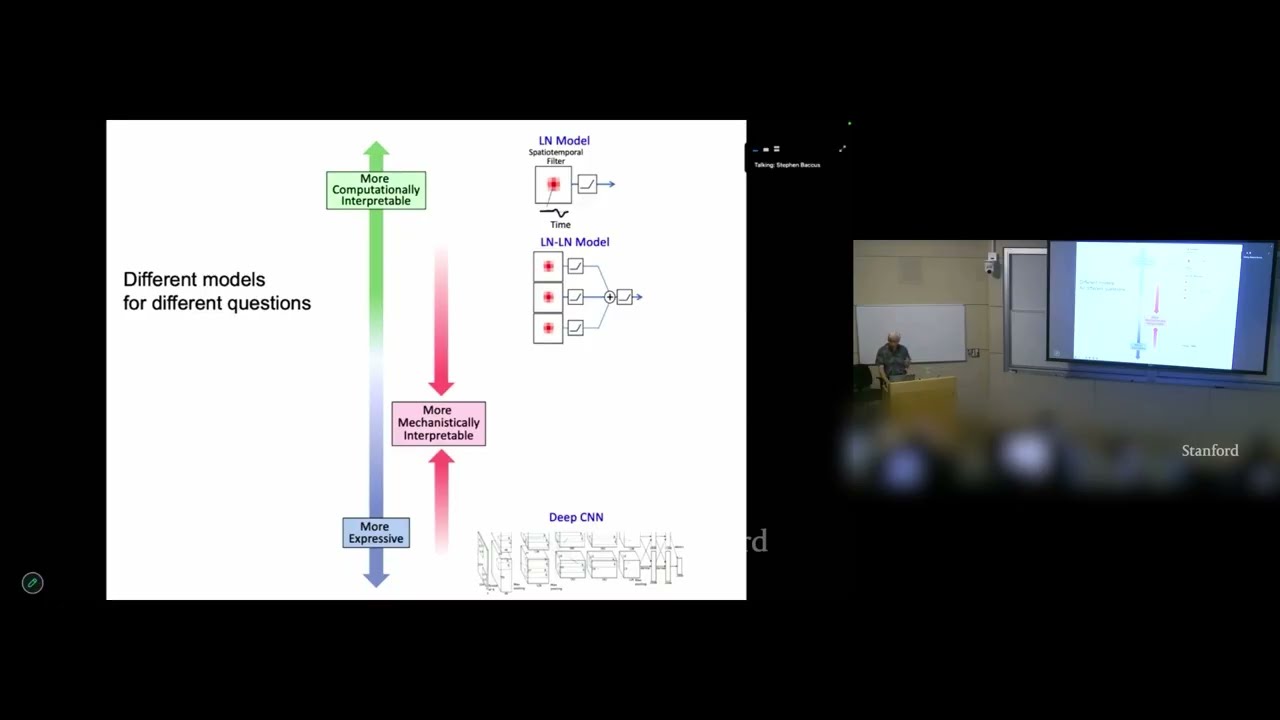
The choice of model architecture is critical: simple Linear-Nonlinear (LN) models are interpretable but limited, while deep models (like CNNs) are highly expressive but data-hungry. The goal is to find a balance that retains interpretability while capturing complexity.
-
The Power of Naturalistic Stimuli
17:30
Training models on natural, complex stimuli (rather than artificial ones) allows the model to generalize and capture sophisticated biological phenomena, such as motion-sensitive cells and predictive responses, even if those phenomena were not explicitly trained.
-
Attribution and Causal Analysis
30:00
Advanced techniques, such as gradient-based attribution and path-based analysis, allow researchers to determine which specific neural pathways (and thus which types of neurons) are responsible for a given output, providing deep mechanistic insights into the system.
Technical details
-
Retinal Circuitry
220s
The retina is composed of three layers of cell bodies: photoreceptors, bipolar cells, and ganglion cells. The circuit involves excitatory paths (photoreceptors to bipolar cells, bipolar cells to ganglion cells) and inhibitory side connections (horizontal and amacrine cells).
-
Computational Models
340s
Models range from simple Linear-Nonlinear (LN) models (local filtering followed by a threshold) to multi-layered structures, including Convolutional Neural Networks (CNNs) and deep architectures like ResNet. The LN-LN model represents a two-layer network.
-
Model Training and Testing
700s
The methodology involves recording responses from retinal ganglion cells (using multi-electrode arrays) to naturalistic stimuli (e.g., natural video footage) and training models to predict the firing rates. The model's success is measured by its ability to reproduce complex phenomena like motion-sensitive cells.
-
Advanced Interpretability Techniques
1900s
To understand non-linear systems, the speaker discusses 'Integrated Gradients' (a method derived from the chain rule) to calculate the total contribution of individual neurons or pathways to the final output, moving beyond simple activation maps.
Mentioned resources
Channel & topics
Watch on YouTube · Back to latest
This independent, AI-assisted summary is provided for commentary and informational purposes. It may contain errors or omit important context. Please watch the original video for the creator's complete presentation. Video, thumbnail, and related copyrights belong to their respective owners.