Stanford CS547 HCI Seminar | Autumn 2026 | Designing AI for Societal Good
Summary
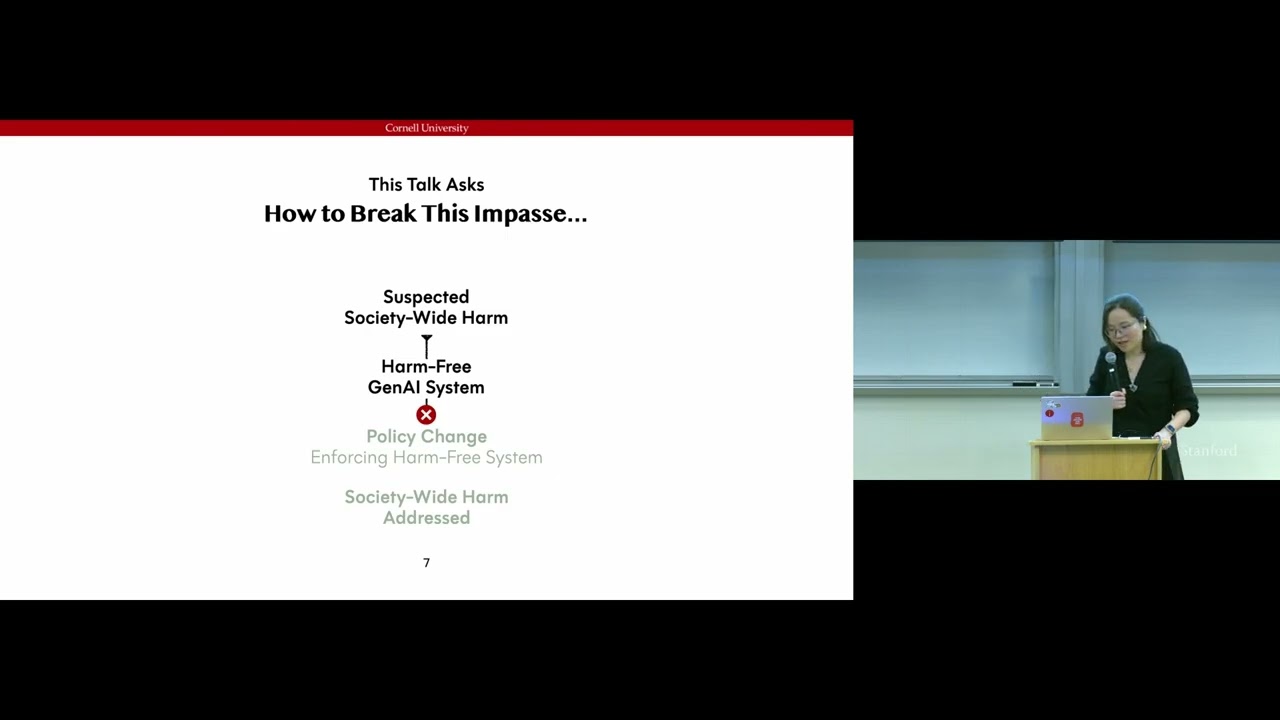
This seminar proposes a paradigm shift in addressing the societal impact of Generative AI, arguing that the focus should move away from merely building 'harm-free' applications. Instead, the research advocates for building 'harm measurement and harm mitigation systems.' The core argument is that effective societal change requires not only technical design but also successfully seeding changes in public opinion, policy, and business models. The process is complex, requiring early investment in measuring societal harms (e.g., mental well-being) and navigating the critical deadlock between funding, public awareness, and policy action.
Key takeaways
-
Shift from Prevention to Measurement
17:21
Instead of building systems that attempt to eliminate potential harms (e.g., making a chatbot less addictive), the focus should be on building systems that measure and quantify societal harms at a population scale. This proactive measurement is crucial because waiting for full understanding is often too late for effective policy intervention.
-
The Centrality of Public Opinion and Funding
23:55
Policy change is not solely driven by technical design or scientific evidence; it is fundamentally dependent on public opinion and political will. Furthermore, the ability to fund large-scale, population-level monitoring of AI impacts (e.g., mental well-being) requires public or government funding, making 'money' the most upstream and critical trigger in the entire workflow.
-
The 'Planting Seeds' Approach
26:40
Successful efforts to address AI's societal impact are best viewed as 'planting seeds'—designing technologies that are intended to catalyze future policy, political, and business model changes, rather than expecting immediate, contained returns.
-
The Importance of Proxy Measures
20:40
Measuring abstract harms (like cognitive engagement or mental well-being) is difficult. The research emphasizes using proxy measures (e.g., analyzing patterns in conversations, measuring time spent on specific activities) rather than relying solely on absolute metrics, which is essential for early-stage intervention.
Technical details
-
Harm Measurement Systems
1240s
The methodology involves developing systems to quantify potential societal harms caused by Generative AI, such as impacts on mental well-being or creativity. This requires adapting proxy measures from cognitive psychology and running large-scale data analysis on user interactions (e.g., analyzing conversational patterns with LLMs).
-
Data Analysis and Monitoring
1240s
Monitoring AI impact requires advanced data techniques, including log analysis and running complex pattern recognition across large datasets. The speaker notes that these measurements are necessary to show aggregated effects that are too small to detect in a small population.
-
System Design for Social Good
1800s
The design process is evolving to incorporate non-technical constraints: regulatory landscapes, existing business models (e.g., Medicare/Medicaid), and political viability. Successful products must be designed to survive and thrive within a capitalistic market structure while providing social good.
Mentioned resources
- Stanford CS547 HCI Seminar
- CHI Workshop on Policy Engagement
Channel & topics
Watch on YouTube · Back to latest
This independent, AI-assisted summary is provided for commentary and informational purposes. It may contain errors or omit important context. Please watch the original video for the creator's complete presentation. Video, thumbnail, and related copyrights belong to their respective owners.