AI News & Strategy Daily | Nate B Jones
Should You Pay $100 A Month For OpenAI's Dots When Meta's Muse Has A Free Version?
Summary
OpenAI's DevDay announcements introduce a major shift toward context-aware, autonomous AI agents (Dots) and collaborative workspaces (Space/Pages), positioning OpenAI as a competitor to Microsoft's enterprise suite. The core thesis is that the value lies not in the agent's form factor, but in its utility—specifically, its ability to maintain and leverage accumulated context for complex, proactive work. Developers are encouraged to focus on building specialized plugins and utilizing APIs like Decisions to embed AI capabilities into existing workflows, creating a multi-agent company structure.
Key takeaways
-
AI Agents (Dots) Focus on Context and Autonomy
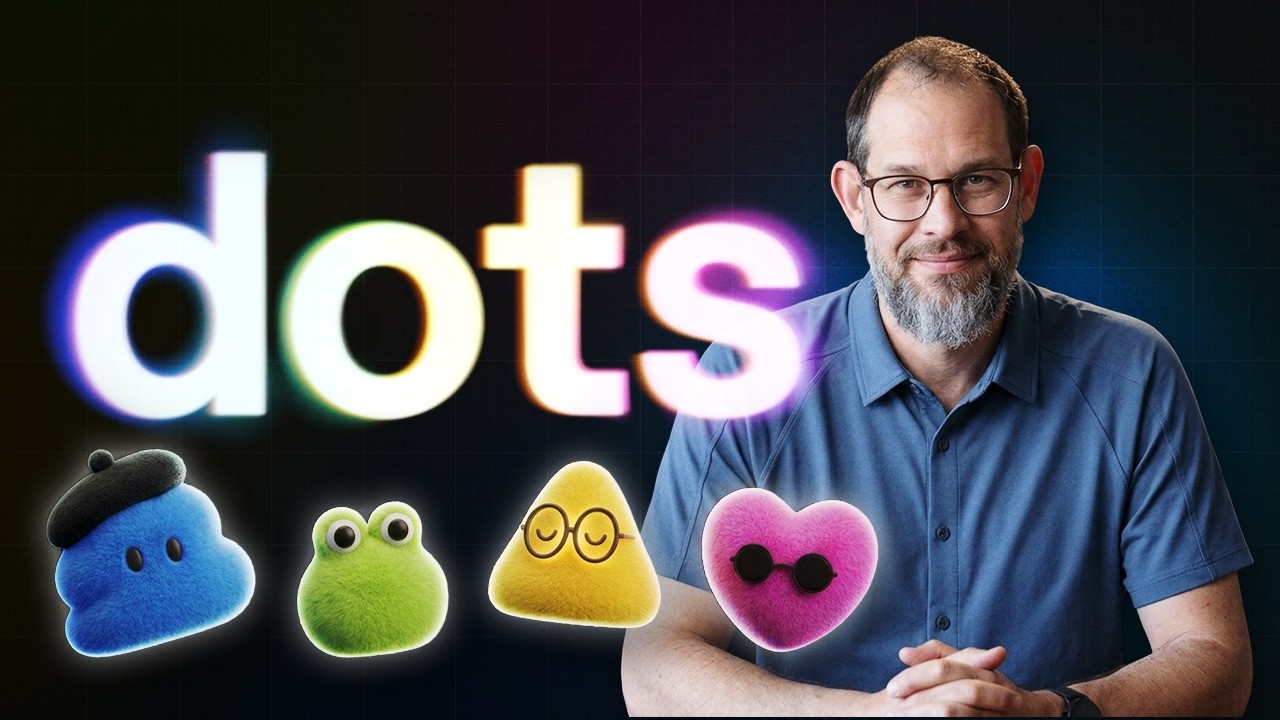
Dots is an agent designed for ongoing responsibilities, possessing a computer, memory, and the ability to work after the user logs off. The value proposition is the ability to leverage accumulated context, moving beyond simple tasks to proactive problem-solving (e.g., cleaning up zombie meetings or spotting scheduling conflicts).
-
GPT-6.1 Sol is an Efficiency Play
20:26
GPT-6.1 Sol is highlighted as a more efficient model compared to Astra, allowing users to perform complex tasks (code, research, documents) while significantly reducing the consumption of the weekly plan allowance. OpenAI reports that Sol approaches Astra on selected evaluations at a fifth of the token prices.
-
The Importance of Utility over Form Factor
While the form factor of agents is converging, the speaker argues that utility is not. Agents will win by excelling at specific, niche jobs (e.g., Muse for low-intelligence life admin, Instinct for travel transactions, Dots for deep work context).
-
Building Opportunities: Decisions API and Plugins
The Decisions API is presented as a key tool for automation, allowing classification (e.g., pricing, release dates) using Luna. Plugin extensions offer a massive opportunity for builders to create specialized, interactive tooling powered by customer APIs, enabling businesses to sell proactive intelligence.
-
Collaborative Spaces (Space/Pages) Challenge Microsoft
25:32
Space and Pages are designed as collaborative digital spaces for people and AI to work together on live documents, directly challenging Microsoft's knowledge work category. This implies a need for AI-fluent, flat organizational structures.
Technical details
-
AI Agent Architecture
1226s
Agents (Dots) are described as having a dedicated cloud computer, memory, and the ability to operate across multiple platforms (web, mobile, Slack, Codeex). The goal is to make context 'intelligent' and accessible for useful work.
-
Model Efficiency and Cost Management
1330s
GPT-6.1 Sol is promoted as a cost-effective alternative to Astra, providing high capability for complex work while minimizing the depletion of the paid plan allowance. The speaker recommends evaluating model usage before assuming the need for higher capacity plans.
-
Development Tools and APIs
1226s
Codeex provides reusable cloud environments for software development. The Decisions API uses Luna to classify and categorize information (e.g., changes, pricing, dates), enabling automation for business processes. Plugin extensions allow external APIs to integrate and shape the ChatGPT ecosystem.
-
Enterprise Collaboration
1532s
Space and Pages facilitate real-time, collaborative work on documents, enabling multiple stakeholders (e.g., sales, product leads) to contribute to a single project space, which is crucial for complex product development cycles.
Mentioned resources
- OpenAI DevDay 2026
- Dots
- ChatGPT Space / Pages
- GPT-6.1 Sol
- Decisions API
Channel & topics
Watch on YouTube · Back to latest
This independent, AI-assisted summary is provided for commentary and informational purposes. It may contain errors or omit important context. Please watch the original video for the creator's complete presentation. Video, thumbnail, and related copyrights belong to their respective owners.