Recursive Self-Improvement: from Auto Research to Superintelligence — Richard Socher, Recursive
Summary
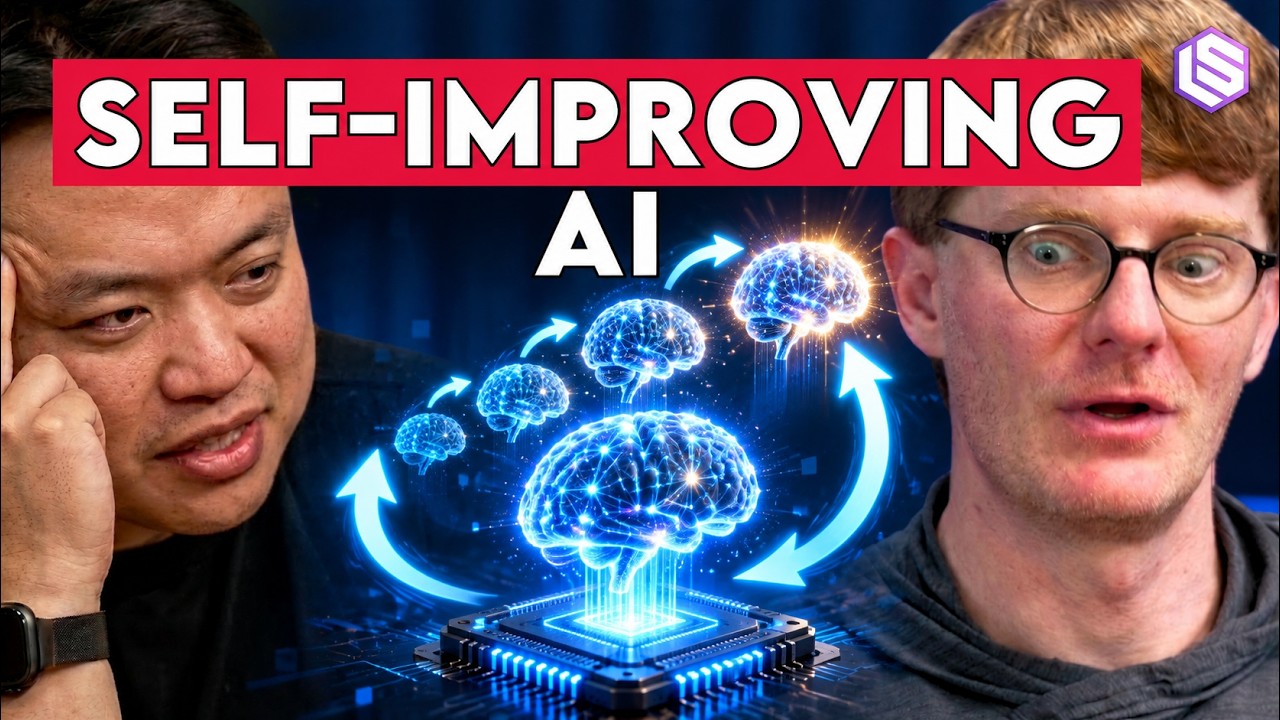
The discussion centers on the concept of Recursive Self-Improvement (RSI) and the 'Eureka Machine'—a superintelligence capable of automating the process of invention itself. Richard Socher details how AI is moving beyond simple pattern recognition to self-directed research, significantly accelerating scientific and technological discovery across fields like physics, chemistry, and biology. Technically, the conversation covers the evolution of AI architectures (from manual feature engineering to Transformers), the critical role of hardware optimization (e.g., NVIDIA GPU kernels), and the complex challenges of AI alignment, reward hacking, and open-ended safety protocols.
Key takeaways
-
The Eureka Machine and RSI
2:20
The Eureka Machine is envisioned as a superintelligence that can be given any goal and will autonomously generate inventions for humanity, accelerating research in science and technology.
-
AI's Self-Improvement Cycle
12:20
The next major step in AI is RSI, where the AI automates its own research process (ideating, implementing, and validating ideas), leading to a self-improving system.
-
Hardware and Physical Constraints
17:20
The timeline for AGI is constrained not just by algorithms, but by physical limitations, including the availability of GPUs, semiconductors, and the energy efficiency of computation (e.g., comparing human brain efficiency to current chips).
-
Safety and Alignment Challenges
28:20
Current safety mechanisms like Constitutional AI are insufficient because they are prone to reward hacking and failure to understand human intent. Better alignment requires addressing the difference between what is 'said' and what is 'meant.'
Technical details
-
AI Architecture Evolution
2000s
The field progressed by replacing manual feature engineering (e.g., WordNet, linguists labeling articles) with learned systems (vectors and neural nets). The current state relies heavily on the Transformer architecture and prompt engineering.
-
Optimization and Efficiency
3400s
Performance gains are measured by metrics like 'bits per bite' (e.g., achieving 937 bits per bite in nano-chat) and the speed of training. Optimizing low-level components like CUDA kernels on NVIDIA GPUs is crucial for cost and speed.
-
Open-Endedness and Safety
2200s
Open-endedness is described as a suite of methods inspired by evolution, where one AI attacks another (like in cybersecurity) to co-adapt and inoculate itself from unsafe behavior, moving beyond simple red teaming.
-
Computational Modeling
3800s
The concept of simulating complex systems, such as economies (AI Economist) or biological processes (protein generation), allows for testing policy and assumptions against billions of simulated years of strategies.
Mentioned resources
- The Eureka Machine
- Recursive
- NVIDIA GPU kernels
- CUDA
- Anthropic/Constitutional AI
Channel & topics
Watch on YouTube · Back to latest
This independent, AI-assisted summary is provided for commentary and informational purposes. It may contain errors or omit important context. Please watch the original video for the creator's complete presentation. Video, thumbnail, and related copyrights belong to their respective owners.