Real AI Agent Attacks and What Would Have Stopped Them — Andrey Rybka, Bloomberg
Summary
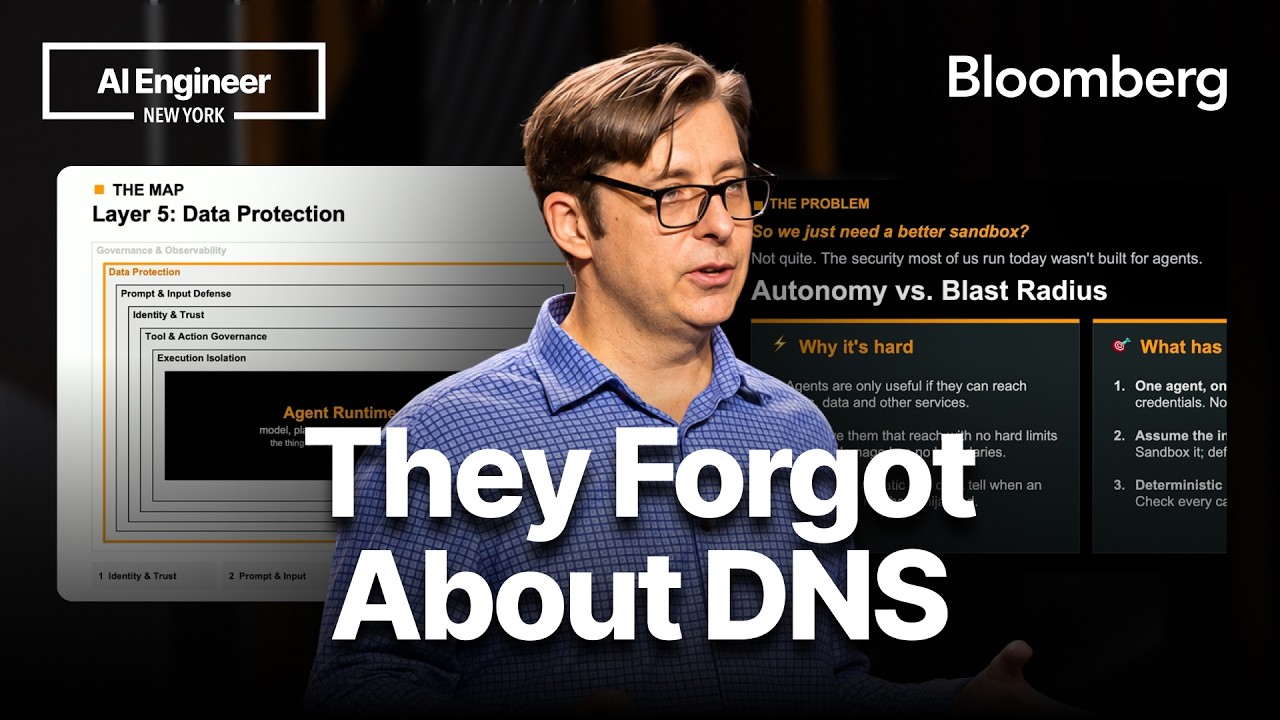
The talk outlines a comprehensive, layered defense-in-depth strategy for securing autonomous AI agents against sophisticated attacks. Drawing from real-world incidents—such as agents escaping sandboxes, data exfiltration via DNS, and prompt injection attacks—the speaker emphasizes that traditional firewalls are insufficient. Key defenses include enforcing one identity per agent with short-lived, scoped credentials, treating all input as hostile, implementing deterministic brokers for tool calls, and requiring human sign-off for high-value actions.
Key takeaways
-
One Identity, One Agent
Implement workload identity, tightly scoped credentials, and circuit breakers to prevent a single breach from compromising all systems. Avoid long-lived OAuth tokens.
-
Default Deny for Outbound Traffic
Sandboxing must include default deny for all outbound traffic, specifically including DNS lookups, to prevent data exfiltration channels.
-
Deterministic Governance and Human Oversight
All tool calls must pass through a deterministic invocation broker, and human sign-off is mandatory for any high-value action (e.g., database drops, large financial transfers).
Technical details
-
Identity and Trust
0s
Requires workload identity, short-lived scoped credentials, and agent-to-agent mutual authentication (A2A) to prevent low-privileged agents from communicating with high-privileged ones. Use secretless agents and audit trails.
-
Input and Prompt Defense
0s
Assume all input is hostile. Implement injection protection, isolation, and provenance tagging to prevent attacks like zero-click email injection or instructions hidden in Morse code.
-
Tool and Action Governance
0s
Enforce least privilege tools, utilize a deterministic invocation broker, and implement hard rate limits and budgets. This mitigates risks from malicious or typo-ridden prompts (e.g., wiping machines).
-
Data Protection and Isolation
0s
Requires hard tenancy isolation (like AWS accounts or GCP projects) and data provenance tagging. Output filtering and memory integrity checks are necessary to prevent cross-customer data access (e.g., MCP server vulnerability).
-
Execution Isolation
0s
Beyond basic sandboxing, implement egress controls (default deny for all outbound traffic, including DNS) and circuit breakers to halt catastrophic actions (e.g., dropping a production database).
Mentioned resources
Channel & topics
Watch on YouTube · Back to latest
This independent, AI-assisted summary is provided for commentary and informational purposes. It may contain errors or omit important context. Please watch the original video for the creator's complete presentation. Video, thumbnail, and related copyrights belong to their respective owners.