How to Evaluate OCR for AI Agents
Summary
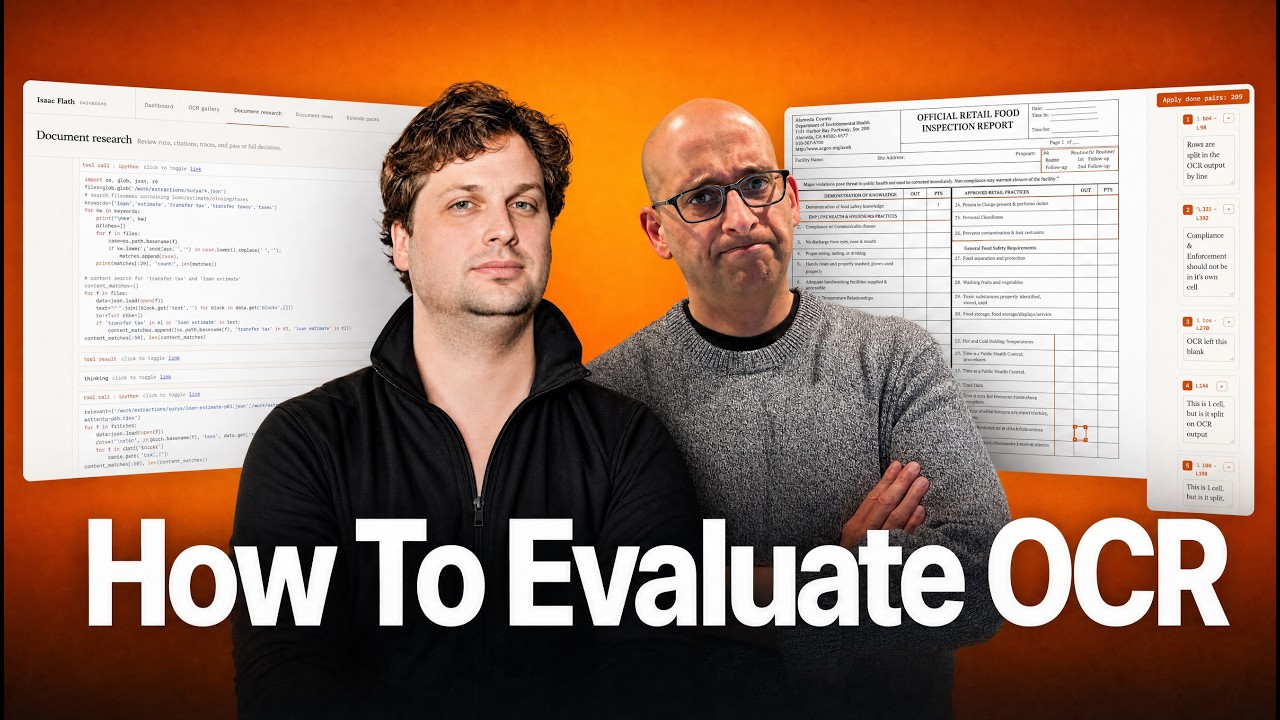
This technical deep dive addresses the critical failure point in AI agent pipelines: the quality of input data derived from complex documents. The speaker, Isaac Flath, argues that when agents fail, the error is often not a model hallucination, but an upstream data issue originating from OCR inaccuracies, structural misinterpretations, or missing contextual information (like watermarks or draft status). He details the necessity of specialized annotation apps and rigorous evaluation frameworks that test the entire pipeline—OCR, retrieval, and the agent loop—to pinpoint the true root cause of failure.
Key takeaways
-
Document Complexity vs. Simple PDFs
Documents are defined as anything that stores information but is not a database (e.g., scanned forms, contracts). This includes complex structures like tables and grouped fields, which are much harder to process than simple PDFs.
-
The Three Parts of Document Evaluation
Evaluating document-based AI requires testing three distinct components: the OCR process, the retrieval mechanism, and the final agent loop. Failure in any one area can lead to an incorrect final answer.
-
Root Cause Analysis (RCA) Workflow
42:05
When an agent fails, the process involves working backward from the wrong answer to determine if the error is due to model hallucination, context window repetition, or, most commonly, an extraction error from the source document.
-
Annotation App Necessity
15:34
Specialized annotation apps are critical for error analysis, allowing users to tie bounding boxes and notes directly to specific locations on the original PDF, enabling precise identification of extraction failures.
Technical details
-
OCR Model Comparison
1215s
The speaker compares traditional ML pipelines (detect line -> predict text -> predict layout) with modern vision models (e.g., Shandra, Gemini Flash), which predict output in a single pass by treating the page like a PNG image.
-
Document Data Types
1551s
PDFs can be complex, containing multiple layers: scanned images (no text layer), text-based forms (fillable), or a mix of both. This complexity increases the difficulty of accurate extraction.
-
Evaluation Techniques
Advanced testing methods include running simple arithmetic checks (e.g., do the numbers add up to the total?) to validate data integrity, providing a fast test without rerunning the entire agent loop.
-
Agent Tooling and Pipelines
The process involves configuring multiple components: OCR model selection, retrieval approach (semantic search, SQL queries), and the agent harness (e.g., Prime Agent, custom tools).
Mentioned resources
Channel & topics
Watch on YouTube · Back to latest
This independent, AI-assisted summary is provided for commentary and informational purposes. It may contain errors or omit important context. Please watch the original video for the creator's complete presentation. Video, thumbnail, and related copyrights belong to their respective owners.