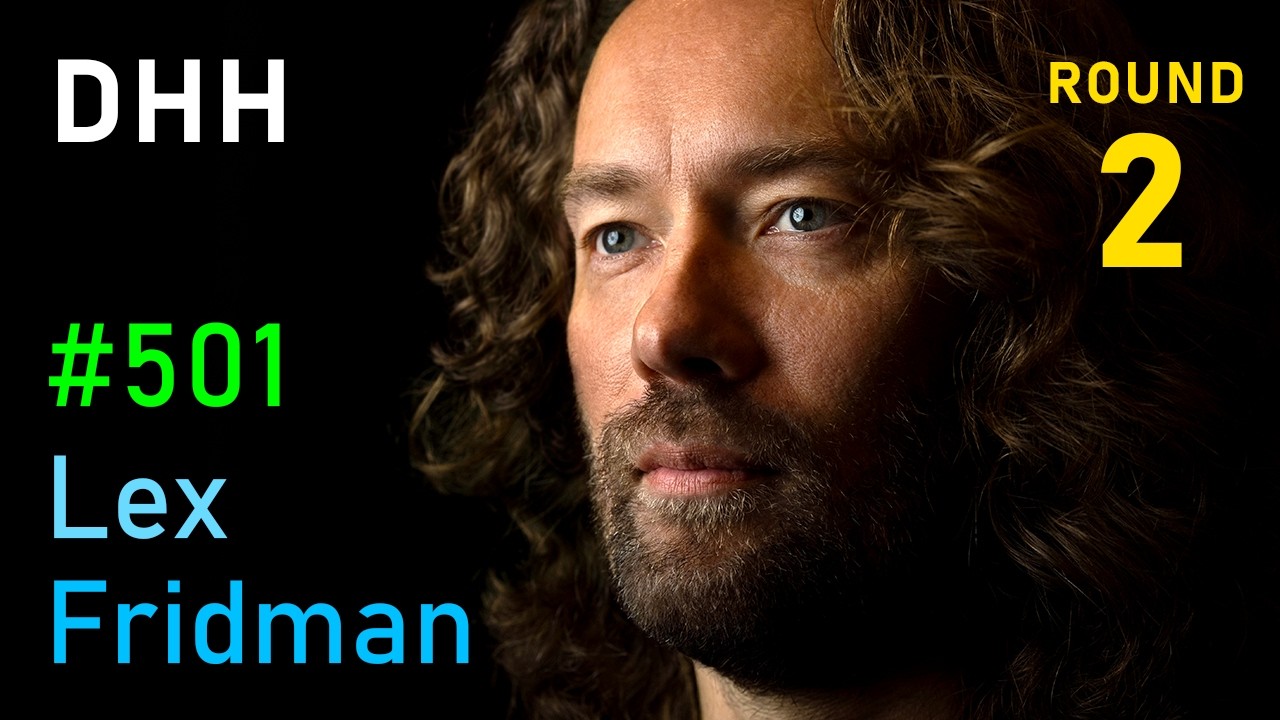
DHH: Future of Programming, AI, Agentic Engineering, Vibe Coding & Linux | Lex Fridman Podcast #501
Summary
The discussion outlines a radical shift in software development driven by AI agents, moving the programmer's role from manual code implementation to high-level system design and vision. The speaker, DHH, details the evolution of AI capabilities—from simple autocomplete to sophisticated agents capable of instrumenting computers and subdividing tasks. He presents Omarchy Linux as a prime example of agent-accelerated development, noting that the current paradigm shift requires engineers to focus on defining the problem (vision/taste) rather than writing the solution (code).
Key takeaways
-
The Acceleration of AI Progress
4:56
AI progress has been unprecedented, with decades of advancement occurring in a matter of months. The shift is characterized by moving from 'autocomplete mode' to sophisticated 'agents' that can check their own work and apply intelligence in ways that fundamentally rewrite the rules of development [2:56].
-
The Agentic Development Workflow
12:04
The current era allows agents to handle the bulk of implementation, making the human role one of defining the fuzzy, vague idea or problem. The speaker notes that the ability to run multiple agents in parallel (e.g., 16 threads) dramatically increases output capacity compared to single-threaded manual coding [1:10:24].
-
Omarchy Linux as a Case Study
37:21
The Omarchy Linux distribution, version Quattro, was built with almost 100% of its code written by agents. The speaker has not written any critical code by hand, demonstrating the viability of agent-driven OS development [37:21].
-
The Importance of Vision over Implementation
12:42
The most critical bottleneck in modern development is not implementation capacity, but 'ideas,' 'vision,' and 'taste.' The agentic age empowers users to build highly customized tools (e.g., Omawrite, a C++/Qt replacement for Typora) for themselves, which can then be easily deployed as open source [1:22:30].
Technical details
-
Agentic Development Tools & Setup
1320s
The workflow requires a shift to parallel processing, utilizing multiple agents. The setup involves using tools like `tmux` and `Herd` (tmux plus agent notifications) to manage multiple concurrent processes. The speaker also leverages KVMs (like GL.iNet Comets) and WireGuard/Tailscale to connect multiple machines into a single, controllable network for scaling compute power [1:10:24].
-
Operating System Architecture
2241s
Omarchy is described as a beautiful, modern, and opinionated Linux system, serving as an alternative to macOS and Windows. Its strength lies in its robust plugin system, which allows agents to create extensions and maintain a cohesive architecture [37:21]. The Unix philosophy, where everything is a config file or CLI tool, is cited as a major advantage for agentic systems [1:32:00].
-
Programming Languages and Paradigms
1320s
The speaker's experience has expanded from Ruby (Ruby on Rails) to C++ and Rust. While acknowledging the technical superiority of languages like Rust for memory safety, he argues that the current value lies in the *malleability* and *coherence* of the architecture, which is now being managed by agents [1:32:00].
-
Development Methodology
1080s
The process is shifting away from upfront specification (the 'spec sheet' model) toward iterative development. The best way to discover what is needed is to build a minimal version, use it, and then refine it, allowing the agent to handle the technical implementation details [1:22:30].
Mentioned resources
- Omarchy Linux
- Ruby on Rails
- 37signals
- Neovim
- Herd
- WireGuard/Tailscale
Channel & topics
Watch on YouTube · Back to latest
This independent, AI-assisted summary is provided for commentary and informational purposes. It may contain errors or omit important context. Please watch the original video for the creator's complete presentation. Video, thumbnail, and related copyrights belong to their respective owners.