Can AI Understand a Distressed Credit? - Harneet Kaur, Axim Intelligence
Summary
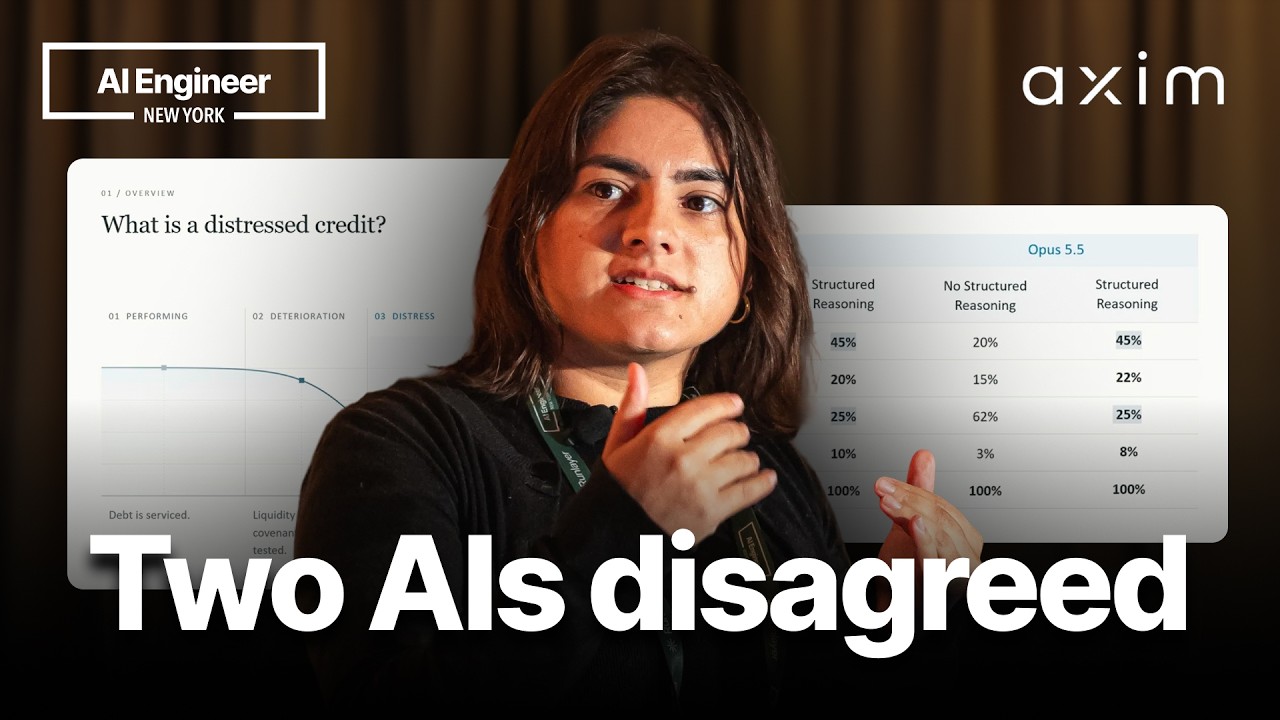
This talk explores the frontier of using AI to understand distressed credit, a complex financial domain. The speaker, Harneet Kaur, details how traditional scoring models (like the Altman Z-score) are insufficient for modern, opaque markets. The core methodology involves building a structured, multi-layered reasoning process (Extraction, Derivation, Judgment, Prediction). A case study using iHeartMedia demonstrated that while top models (Astra 6, Opus 5.5) initially disagreed on future probabilities, forcing them through this structured framework led to a convergence of their predictions, suggesting that systematic process design is critical for achieving consensus in complex financial modeling.
Key takeaways
-
Structured Reasoning Drives Model Convergence
When models are subjected to a structured reasoning process—benchmarking each layer (Extraction, Derivation, Judgment)—they converge on similar probabilistic outcomes, even when predicting non-verifiable future events. This suggests that systematic process design is key to achieving consensus in complex analysis.
-
Distress is Multi-faceted, Not Binary
Distress is not simply predicting bankruptcy; outcomes can include liability management exercises or out-of-court restructuring. The analysis must consider financial, legal (e.g., structural priority of debt), and operational issues.
-
The Limitation of Prediction
The speaker notes that even with structured context, the models do not have a predictive edge over human agents, as the future remains non-verifiable. However, the convergence itself is a valuable systemic outcome.
Technical details
-
Distressed Credit Definition
0s
Credit is a bond or loan of a corporation. Distress occurs when underlying risks threaten the company's ability to pay back debt, caused by cyclical issues (e.g., construction market downturn) or secular disruption (e.g., AI disruption).
-
Traditional Scoring Limitations
234s
Traditional methods, such as the Altman Z-score, are becoming static and insufficient due to the rise of private credit and lack of pricing transparency in the market.
-
AI Reasoning Layers
801s
The proposed systematic analysis breaks down understanding into four layers: 1) Extraction (data points like EBITDA); 2) Derivation (calculating metrics like leverage); 3) Judgment (assessing if the credit is distressed); and 4) Prediction (determining future probability distributions).
-
Case Study Models
613s
The analysis used iHeartMedia (a company that filed for bankruptcy in 2018 and had a stressed transaction in 2024) and compared the outputs of Astra 6 and Opus 5.5.
Mentioned resources
Channel & topics
Watch on YouTube · Back to latest
This independent, AI-assisted summary is provided for commentary and informational purposes. It may contain errors or omit important context. Please watch the original video for the creator's complete presentation. Video, thumbnail, and related copyrights belong to their respective owners.