Building with Gemma 4
Summary
Gemma 4 is presented as a family of open models from Google designed for on-device deployment, offering a powerful alternative to cloud-based models like Gemini. The core capability demonstrated is running AI models locally—from phones to workstations—enabling applications that require high speed, low latency, and operation in environments with no internet connectivity. Featured builds include a conversational robot, a wearable robotic arm, remote wildlife data analysis, and offline coding assistance.
Key takeaways
-
On-Device AI Deployment
Gemma 4 allows developers to download model weights, run them locally, fine-tune them, and deploy them on various hardware, including phones, Raspberry Pi, and workstation GPUs. This capability is crucial for maintaining privacy and ensuring fast performance without relying on cloud connectivity.
-
Offline Functionality
2:00
Multiple use cases, such as PenguinAgent for wildlife research and CodeBuddy for student coding, demonstrate that complex AI tasks (video analysis, code reading, debugging) can function entirely offline, even in remote areas.
-
Specialized Model Use Cases
The video showcases specialized models: LFG-3 Turbo (for conversational AI), a fine-tuned, lighter-weight Gemma 4 model (for real-time robotic control), and a Gemma 4 26B model (for large-scale video/sensor data analysis).
Technical details
-
Model Architecture & Deployment
0s
Gemma 4 is an open model family that allows developers to download weights for local execution. This contrasts with Gemini, which runs in the cloud. The process includes local fine-tuning and deployment across diverse hardware.
-
Conversational AI
20s
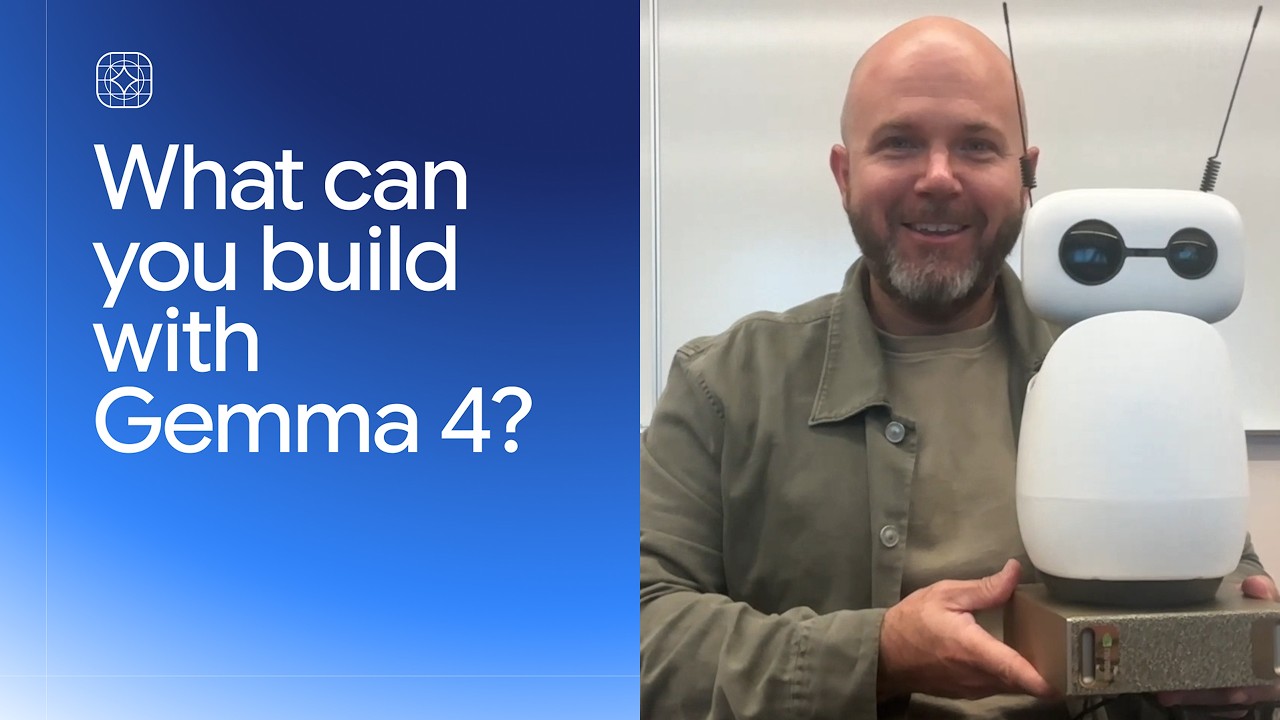
The conversational robot is powered by LFG-3 Turbo, which is based on Gemma 4 and provides high-speed, completely offline chat capabilities.
-
Robotics and Edge Computing
45s
A wearable robotic arm uses a larger Gemma model for labeling training footage, while a fine-tuned, lighter-weight Gemma 4 model handles real-time, on-device processing of camera and speech input to generate movement commands.
-
Remote Data Analysis
75s
PenguinAgent utilizes a Gemma 4 26B model running locally to analyze video and sensor data, answering questions against a library of scientific papers without requiring any network signal.
-
Offline Coding Assistance
105s
CodeBuddy uses Gemma 4 E4B to read, run, and debug Python code from a photo taken of a student's handwritten notes, all offline.
Mentioned resources
Channel & topics
Watch on YouTube · Back to latest
This independent, AI-assisted summary is provided for commentary and informational purposes. It may contain errors or omit important context. Please watch the original video for the creator's complete presentation. Video, thumbnail, and related copyrights belong to their respective owners.