An AI Future Without the Lock-In — Remy Guercio, Tailscale
Summary
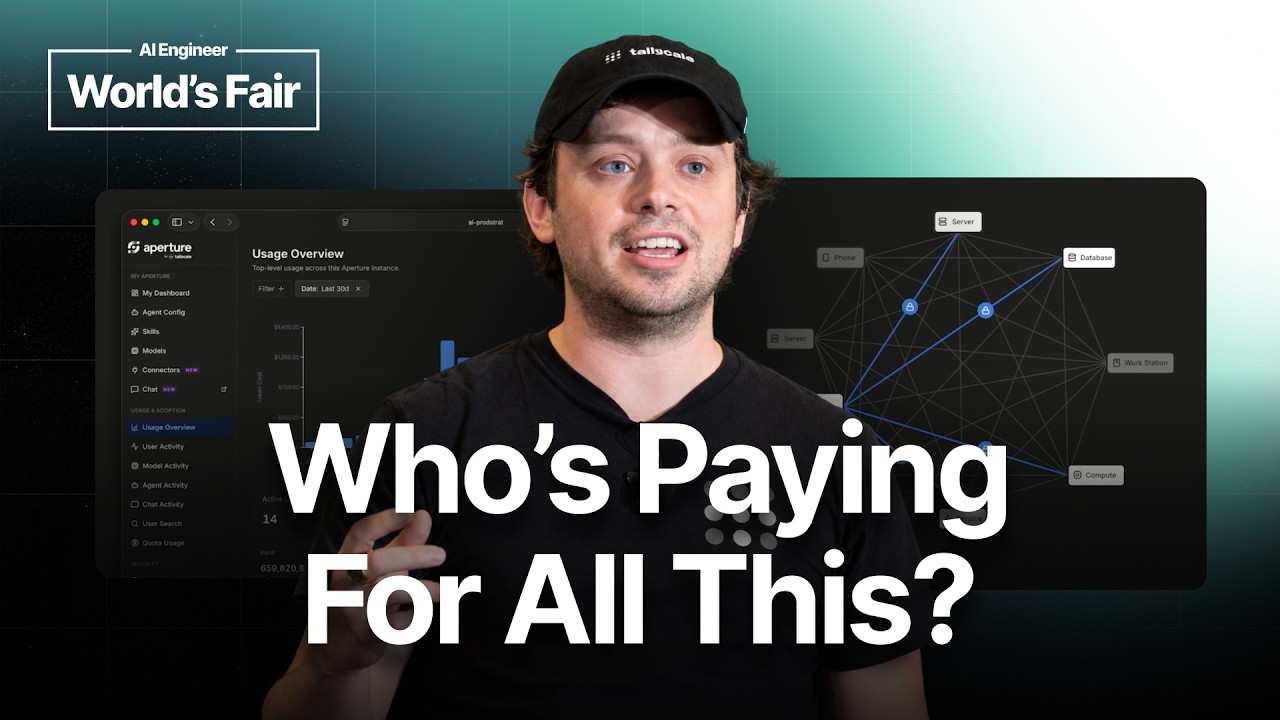
The talk addresses the industry shift from 'token maxing' (unlimited AI budgets) to 'ROI maxing' (proving measurable return on AI investment). Remy Guercio argues that the primary risk in current AI deployments is vendor lock-in due to vertically integrated toolchains. He proposes that an AI gateway, specifically Aperture (built on Tailscale), is essential for decoupling the AI stack. This gateway centralizes identity, manages budgets per model, and acts as a unified LLM and MCP gateway, allowing teams to swap components (models, data connectors, interfaces) without rebuilding their entire system.
Key takeaways
-
Shift from Token Maxing to ROI Maxing
8:34
The era of unlimited AI budgets is ending. Organizations must move beyond simply spending tokens and instead focus on proving concrete Return on Investment (ROI) by maximizing choice and minimizing vendor lock-in. (2:05, 5:14)
-
The Four Layers of an AI Stack
10:09
An internal AI deployment consists of four critical, separable layers: 1) LLMs, 2) Data Connectors (e.g., MCP, CLIs, APIs), 3) The Interface (e.g., chat UI, Slack), and 4) Sandboxes (the execution environment). To achieve ROI maxing, choice must be maintained at every one of these layers. (6:09)
-
AI Gateway Functionality
13:29
An AI gateway (like Aperture) sits between the agent/interface and all endpoints (LLM and data). It provides centralized control and monitoring for security, cost, and debugging, allowing users to trace agent actions and diagnose failures. (8:09, 18:04)
-
Identity-Based Access Control
16:49
Aperture leverages Tailscale, an identity-based mesh network built on WireGuard. This ensures that every connection—whether from a user or an agent—is authenticated by the machine or user identity (the 'tag'), eliminating the need to manage multiple shared API keys. (10:09)
Technical details
-
AI Gateway Architecture (Aperture)
Aperture functions as both an LLM gateway and an MCP gateway. It centralizes API key management for multiple LLM providers (e.g., Anthropic, OpenAI, Google) and allows for granular budget control (e.g., unlimited budget for cheap models, tight budget for frontier models). (12:44)
-
Data Connector Management (MCP)
The gateway allows administrators to configure and control which MCP servers are accessible. It uses the established identity to grant specific access rights (e.g., Marketing team gets access to Google Calendar; Engineering team gets read-only access to GitHub). (14:04)
-
Authentication and Decoupling
By handling authentication centrally, the gateway ensures that any tool (Cursor, Claude Code, Codex, or custom agents) can connect via a single endpoint, making the switching cost between tools significantly lower. (16:49)
-
Identity Pass-Through
The system supports passing through OpenID (OIDC) to maintain user and machine identity visibility, even when using custom or third-party interfaces (e.g., open web UI). (17:30)
Mentioned resources
Channel & topics
Watch on YouTube · Back to latest
This independent, AI-assisted summary is provided for commentary and informational purposes. It may contain errors or omit important context. Please watch the original video for the creator's complete presentation. Video, thumbnail, and related copyrights belong to their respective owners.