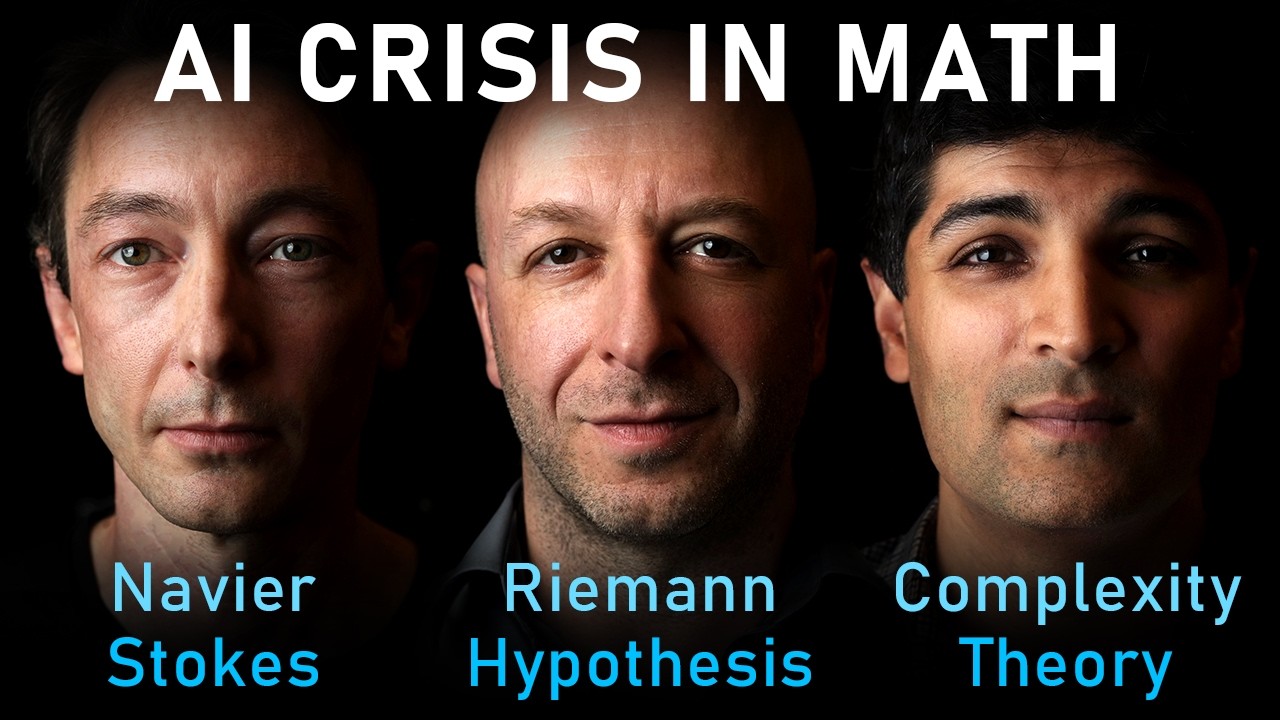
AI Crisis in Math: Navier-Stokes, Riemann Hypothesis & Complexity Theory | Lex Fridman Podcast #503
Summary
The discussion analyzes the current 'crisis moment' in mathematics, triggered by AI systems solving historically difficult problems like the Navier-Stokes equations, the quasi-Riemann hypothesis (quasi-RH), and the unique games conjecture. Experts debate whether this represents the end of human mathematical endeavor or a new 'golden age.' Key themes include the shift toward formal, machine-checkable proofs using tools like Lean and Mathlib, the critical distinction between pure mathematical insight (the 'why') and mere problem-solving (the 'what'), and the profound implications for fields like fluid dynamics and cryptography.
Key takeaways
-
AI's Impact on Mathematical Proofs
2:51:40
AI systems are capable of solving problems that were previously thought to require decades of human effort. The formalization of Fermat's Last Theorem (FLT) into 13 million lines of Lean code demonstrated the power of autoformalization, moving mathematics toward a 'crowdsourced' model where proofs are built on verifiable, general libraries (Mathlib).
-
The Nature of Progress: Semigroup vs. Convex Hull
Experts debate if AI progress is merely interpolating known human knowledge (within a 'convex hull') or if it is genuinely extrapolating by combining existing ideas in novel ways (a 'semigroup' action). The consensus is that human insight—asking the right questions—remains crucial for defining new boundaries.
-
Fluid Dynamics and Navier-Stokes
3:11:40
The Navier-Stokes equations, which model the conservation of momentum for fluids, are fundamental to engineering. The difficulty lies not just in writing the equations (which is simple) but in solving them and predicting complex phenomena like turbulence, which requires advanced simulation and understanding of physical boundaries (e.g., molecular scale).
-
The Role of Human Insight
3:28:20
The value of a mathematician shifts from being the sole solver of theorems to being the conceptual architect. The most valuable human contributions are seen as building new theories, making new definitions, and asking the right, guiding questions, rather than just producing a final result.
Technical details
-
Navier-Stokes Equations
11500s
A partial differential equation describing how the velocity field of a fluid changes in space and time, based on the conservation of momentum (F=ma). The challenge lies in predicting complex phenomena like turbulence and determining if the equations admit solutions that blow up in finite time.
-
Riemann Hypothesis (RH) / Quasi-RH
The RH concerns the distribution of prime numbers, specifically predicting that the non-trivial zeros of the Riemann zeta function lie on the line where the real part equals 1/2. The recent proof of the quasi-RH established a vertical strip where no zeros exist, representing a major step toward the full hypothesis.
-
Formal Verification and Mathlib/Lean
10300s
Lean is an interactive theorem prover, and Mathlib is the associated library for formalizing mathematics. This process allows mathematical results to be checked down to the axioms, ensuring 'sorry-free' proofs and enabling a systematic, reproducible, and crowdsourced approach to mathematics.
-
Complexity Theory
800s
The discussion touches on the 'solved axiom': the hypothesis that any problem solvable by human interaction with AI could also be solved by AI alone. Experts debate the validity of this axiom, arguing that human value lies in the exploratory process and conceptual leaps.
Mentioned resources
- Lean
- Mathlib
- Navier-Stokes Equations
Channel & topics
Watch on YouTube · Back to latest
This independent, AI-assisted summary is provided for commentary and informational purposes. It may contain errors or omit important context. Please watch the original video for the creator's complete presentation. Video, thumbnail, and related copyrights belong to their respective owners.