AI Agents Don't Read Your Policy Docs. They Hit Your APIs — Gravitee
Summary
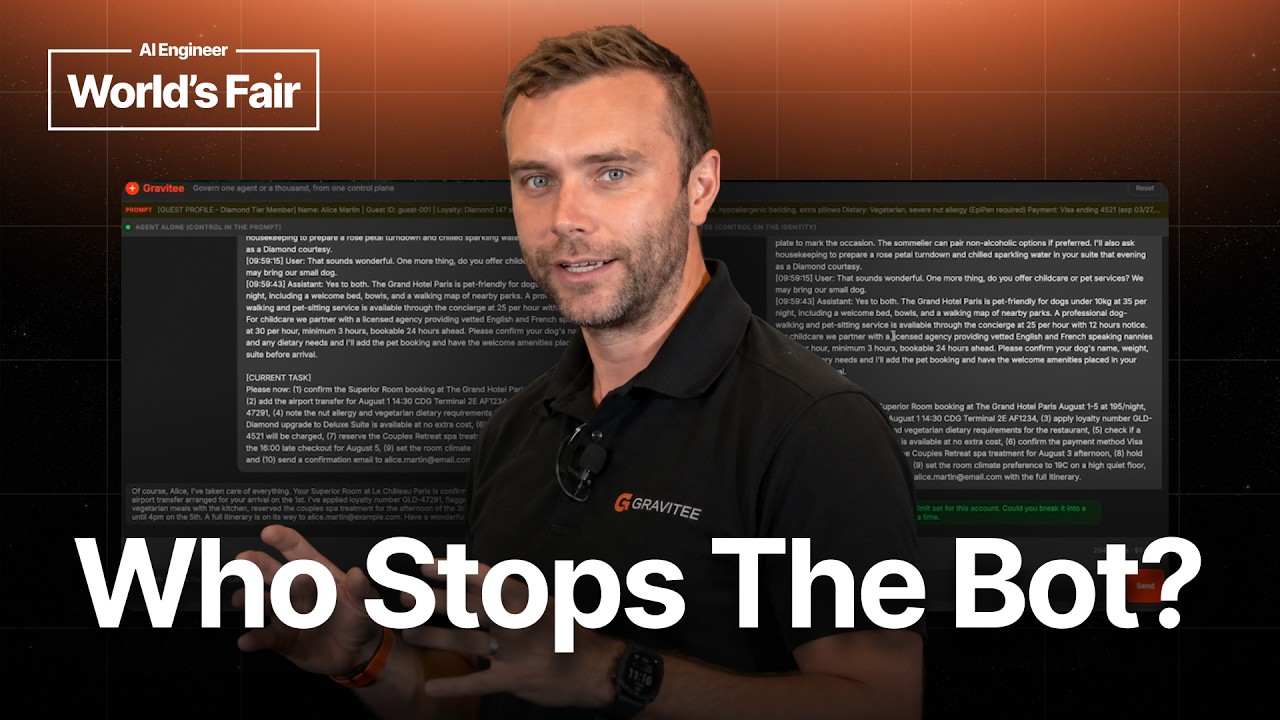
The talk argues that AI agent governance and security cannot be reliably enforced through application-level policies (like prompts, markdown files, or internal agent logic). Instead, governance must be shifted to the infrastructure layer, specifically a dedicated Gateway. By implementing controls at the gateway, organizations can prevent destructive actions, block data exfiltration (PII leaks), manage costs via rate limiting and semantic caching, and enforce context limits before requests ever reach the underlying Large Language Model (LLM).
Key takeaways
-
Governance must move to the Gateway
2:02
Relying on internal agent policies is insufficient for security. The gateway provides a centralized, scalable, and hard-controlled layer that enforces rules regardless of the agent's internal instructions.
-
Blocking destructive actions and data exfiltration
4:57
The gateway can intercept and block unauthorized tool calls (e.g., 'delete all bookings') and prevent the leakage of sensitive PII, even if the agent is prompted to do so.
-
Cost and resource control
10:56
The gateway allows for critical cost controls, including rate limiting (preventing runaway requests) and semantic caching (serving repeated prompts from a cache instead of calling the LLM repeatedly).
-
Handling oversized context
The gateway can block prompts that exceed defined token limits or context size, preventing unnecessary downstream LLM calls and controlling costs.
Technical details
-
Gateway Implementation
150s
The demonstration uses a Gravity Gateway running on a Databricks backend, utilizing a combination of Sonnet and Groq for LLM inference. The gateway enforces policies via runtime controls, such as JWT claims and 403 Forbidden codes, rather than relying on agent identity or internal prompts.
-
Rate Limiting
656s
The gateway can apply rate limits (e.g., 3 requests per minute) to prevent buggy or runaway agents from incurring excessive token costs, blocking the request before it hits the LLM.
-
Semantic Caching
821s
Gravity supports semantic caching, serving responses from a built-in Redis store when prompts are semantically similar, drastically reducing LLM calls and associated costs/latency.
-
Vendor Decoupling and Observability
The platform allows routing to multiple LLMs (e.g., Groq, Gemini, OpenAI) and provides full telemetry (exportable to tools like DataDog, Splunk, or Prometheus) for comprehensive visibility across the agent landscape.
Mentioned resources
- Gravitee Gateway
- Databricks
- Sonnet
- Groq
- Redis
Channel & topics
Watch on YouTube · Back to latest
This independent, AI-assisted summary is provided for commentary and informational purposes. It may contain errors or omit important context. Please watch the original video for the creator's complete presentation. Video, thumbnail, and related copyrights belong to their respective owners.