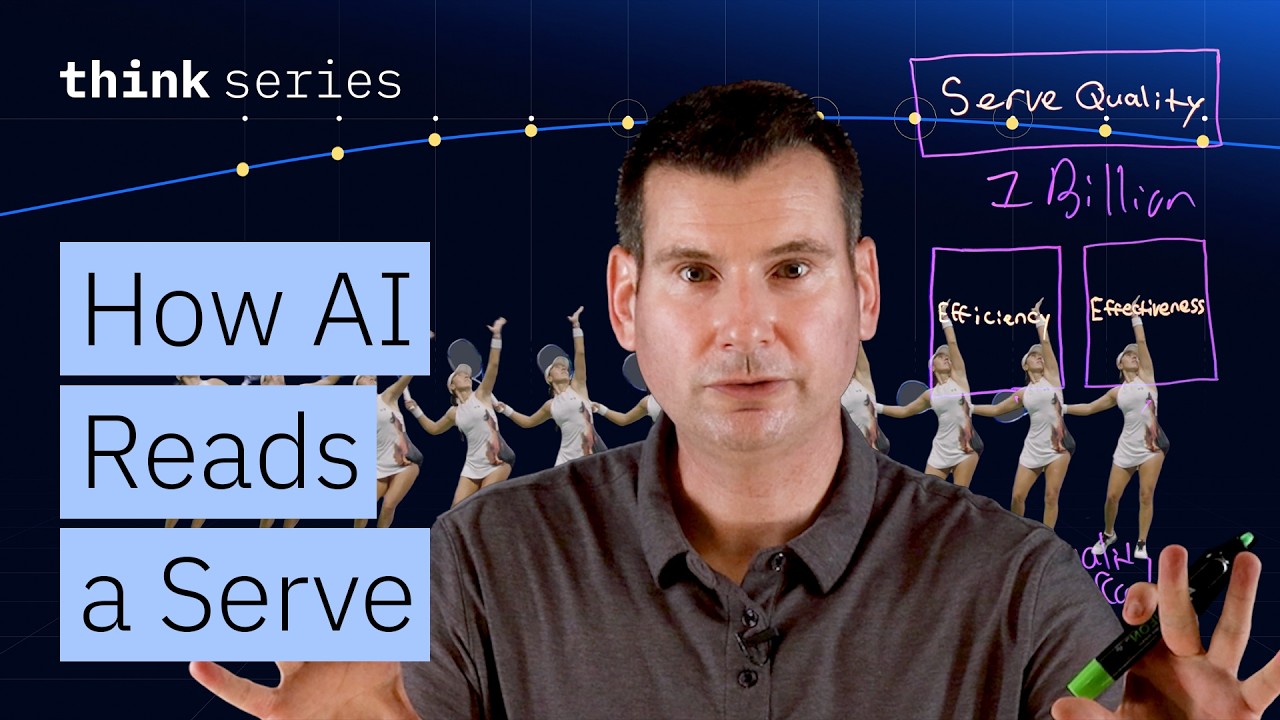
How AI Agents, LLMs & APIs Use Real-Time Data at the US Open
This video details an AI-infused system at the US Open that analyzes tennis serves by combining specialized APIs with Large Language Models (LLMs) via AI Agents. The core architectural pattern involves specialized backend services handling massive, complex data processing (e.g., biomechanics and joint tracking) and returning structured, actionable scores. The LLM then uses these scores, rather than raw data, to perform high-level reasoning and generate human-readable insights for the user. This approach effectively divides labor between specialized computation and natural language reasoning.
Key takeaways
-
The Limitation of Raw Data for LLMs
LLMs, while excellent at general knowledge, struggle with raw, high-volume numerical crunching, such as processing 21 tracked joints at 50 times per second, which generates millions of position values. Raw data is too large and complex for effective reasoning.
-
The Role of Specialized APIs
APIs and specialized services are necessary to process raw data streams into structured, meaningful metrics. For the US Open, this process generates two key scores: **Efficiency** (biomechanics, joint separation) and **Effectiveness** (outcome stats like speed and placement).
-
The AI Agent Workflow
0:07
An AI Agent acts as an orchestrator, using a defined list of tools (APIs). When prompted, the agent outputs a structured request, which is executed by the API. The API returns the processed data, allowing the LLM to complete the reasoning cycle and answer the user's question.