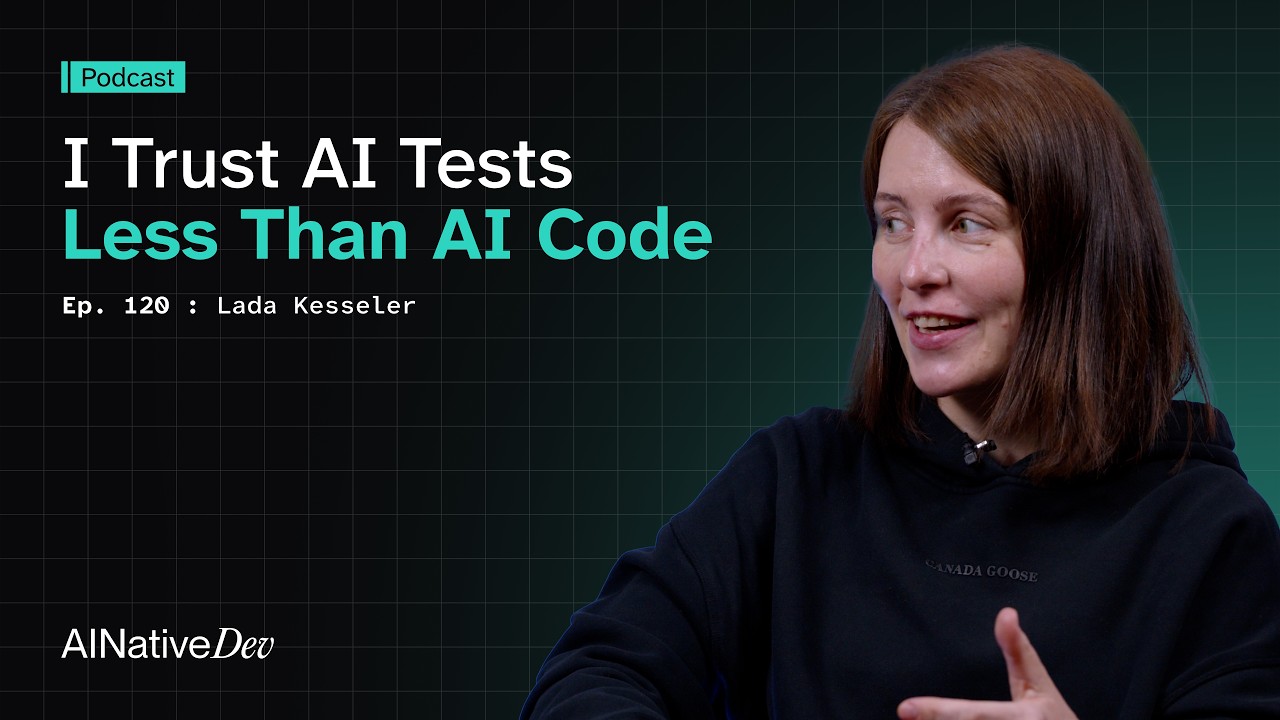
Lada Kesseler: I Trust AI Tests Less Than AI Code
Lada Kesseler discusses advanced agentic workflows, arguing that achieving quality with AI agents requires structured 'loop engineering' rather than expecting perfect first attempts. She emphasizes giving agents explicit missions to disagree with and recommends techniques like iterative refinement (the 'centrifuge') and using specialized skills (like TDD) via front matter activation. For build engineers, the core message is shifting from monolithic code generation to modular, verifiable processes that manage complexity through deterministic triggers and layered testing.
Key takeaways
-
The Centrifuge Principle
11:39
Quality requires iterative refinement; do not expect AI-generated output to be perfect on the first try. The process involves taking one step, committing it to a file, reading it back, identifying flaws, and repeating the loop until satisfactory (00:13:09).
-
Agent Ground Rules are for Agents, Not Humans
10:22
The 'ground rules' or system prompts must give the model a mission to disagree with you (e.g., 'Don't try to please me') rather than just listing best practices. The description field in an agent skill is intended for machine activation, not human readability (00:10:02).
-
Sketch Prototypes with Markdown
20:43
For early-stage architecture or complex problem spaces, replace code with a markdown file and an agent. This allows the user to experience the workflow's user experience without committing to production code, serving as a fast, low-fidelity prototype (00:20:43).
-
Deterministic Verification is Key
27:28
Use 'verifiers' or deterministic triggers that check for specific standards (e.g., long methods, adherence to style guides) across various files, providing far better results than a single general code review prompt (00:35:29).