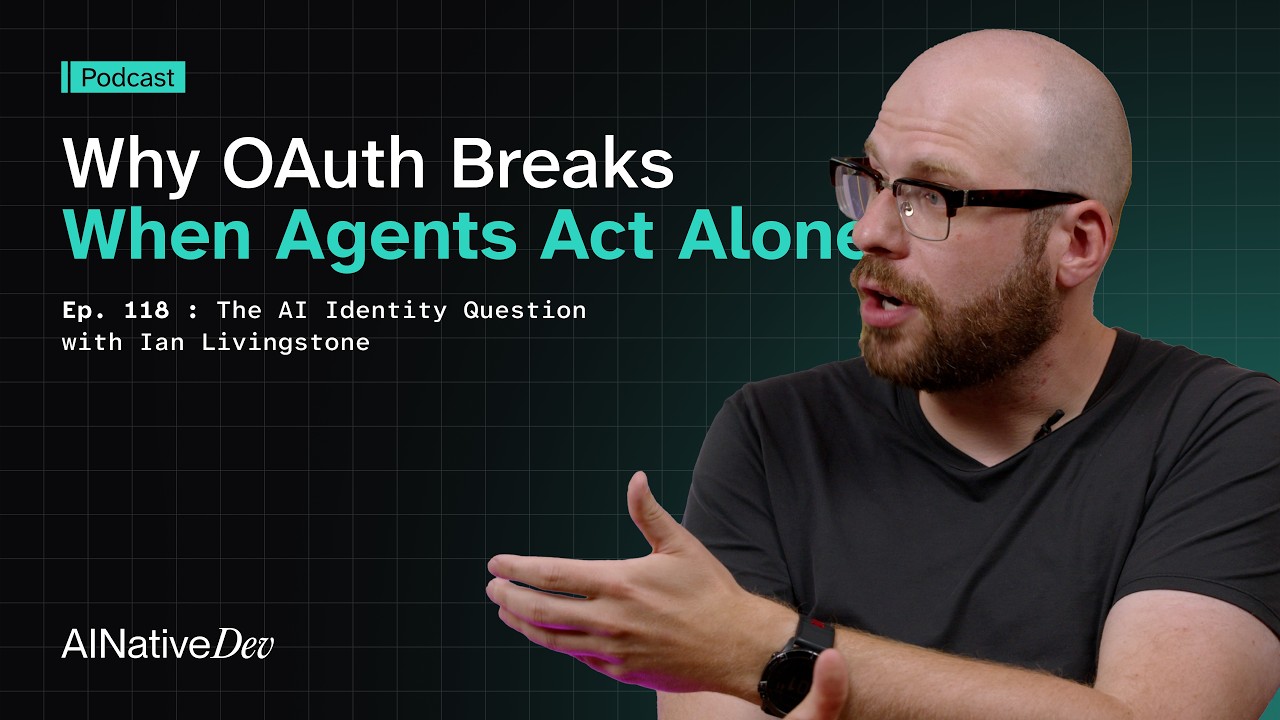
The Background Check You Can't Run on an AI Agent
The increasing autonomy of AI agents introduces a fundamental security challenge: non-determinism. Traditional cloud-era identity systems (relying on shared secrets or basic authentication) are insufficient because they cannot verify the agent's intent or ensure its actions align with human goals. The solution requires shifting focus from simple 'who is acting' to complex 'mission identity,' which defines *what* the agent was assigned to do and provides granular, task-based authorization boundaries (hard boundaries/sandboxing) to prevent catastrophic unintended actions.
Key takeaways
-
Non-Determinism: The Feature and the Bug
17:03
The core capability of agents—reasoning and guessing over large data sets, leading to non-deterministic behavior—is simultaneously their greatest feature and their biggest security vulnerability. This necessitates new architectural controls.
-
Shift from Authentication to Mission Identity
36:56
The identity problem is evolving beyond verifying a user's existence (authentication) or even their general permissions (authorization). The new requirement is 'Mission Identity,' which defines the agent's purpose, scope, and intended actions over time, enabling accountability for delegated authority.
-
The Need for Hard Boundaries
22:16
To manage risk, systems must implement hard boundaries (sandboxing) that prevent catastrophic failures. This is critical because agents lack human judgment and cannot inherently distinguish between 'I know' and 'I don't know.'
-
The Evolution of Protocols
46:47
New protocols are emerging to solve this, including Cross App Access (an evolution of OAuth) and a net-new standard called Agent Auth. These aim to move away from long-lived shared secrets.