Topic

Agentic AI Security

All digests tagged Agentic AI Security

· 1:01:49

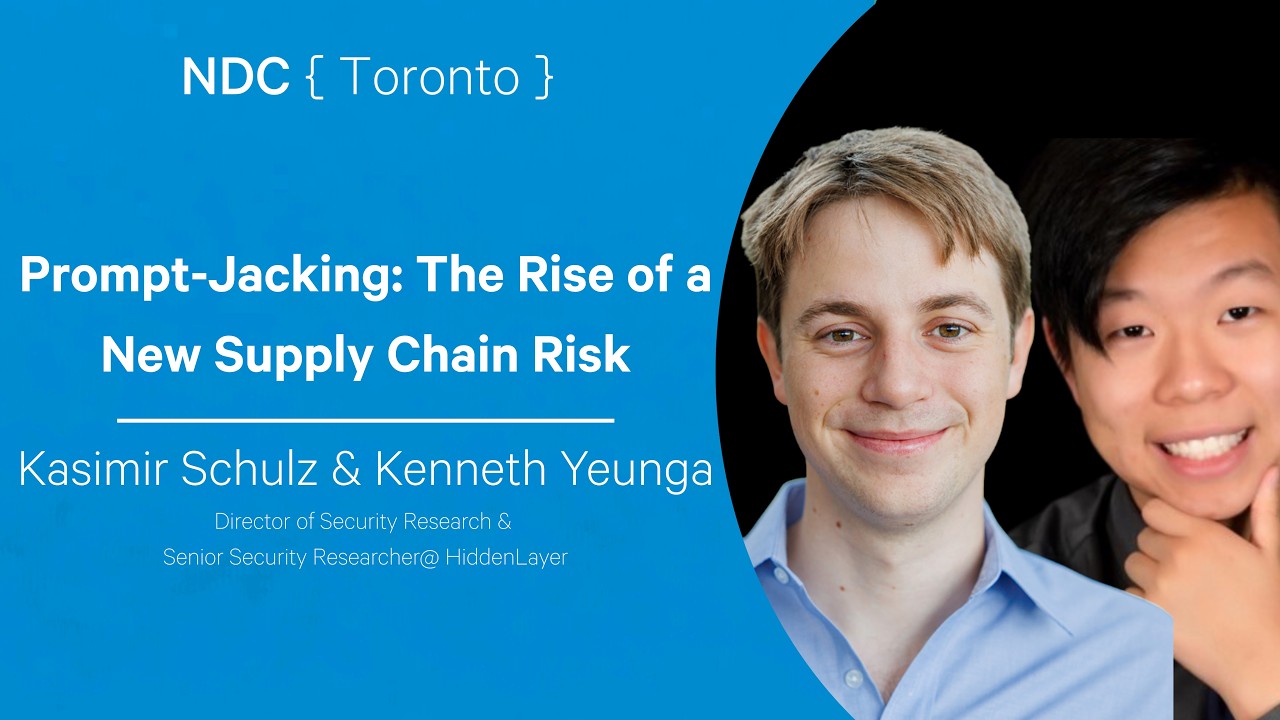
Prompt-Jacking: The Rise of a New Supply Chain Risk - Kasimir Schulz & Kenneth Yeung

The talk details how AI coding assistants and agentic systems introduce novel supply chain risks by allowing attackers to compromise developers through hidden text or malicious prompts. Vulnerabilities are often found not in traditional code flaws but in the design of agents themselves. Key attack vectors include indirect prompt injection via raw file data (e.g., READMEs), exploiting tool call responses, manipulating control sequences, and abusing structured formats like JSON within automated pipelines.

Key takeaways

  1. Inspect Raw Data Sources 2:00

    When reviewing codebases or documentation, always check the raw markdown/HTML data (e.g., a README file) rather than just the pre-rendered view, as malicious payloads can be hidden in comments or unrendered sections.

  2. Guardrails are Not Enough 10:30

    While guardrails (LLM as a judge, classification models) are useful, they can be bypassed by advanced techniques like recursive prompt injection or token manipulation. Security must address architectural weaknesses beyond just the prompt.

  3. Separate Control and Data Planes 17:45

    A critical defense is ensuring a strict separation between system instructions (the control plane) and user/tool input data (the data plane). LLMs often fail to distinguish between these two, making this separation crucial for security.

  4. Audit All Skills and Tools 28:00

    When using agentic skills or tools (e.g., in OpenWebUI), audit the skill's name, description, and parameters, as these are often inserted into the system prompt at a high privilege level and can be exploited for injection.

Watch on YouTube Full article

· 56:53

Fine-Grained Authorization: The Missing Piece in Agentic AI Security - Shivay Lamba - NDC Sydney

As Generative AI and agentic systems become more integrated into enterprise workflows, securing data access is paramount due to increased attack vectors. This talk emphasizes that traditional Role-Based Access Control (RBAC) is insufficient for modern AI applications. The solution proposed is Fine-Grained Authorization (FGA), specifically utilizing Relationship-Based Access Control (ReBAC). OpenFGA is presented as a robust, scalable tool that allows developers to enforce document-level permissions at runtime, ensuring that LLMs and agents can only access data explicitly authorized by the user's role and context. This approach is critical for securing Retrieval-Augmented Generation (RAG) pipelines against sensitive information disclosure.

Key takeaways

  1. AI Agents Require Guardrails 1:47

    Agentic systems, while powerful, must be constrained by proper security guardrails. Analogies like the Harbor Bridge and designated swimming areas illustrate that actions must be limited to authorized boundaries.

  2. FGA is Necessary for GenAI Security 20:40

    The most critical security risk in LLM applications, from an application developer's perspective, is Sensitive Information Disclosure. FGA ensures the AI respects user roles and permissions when accessing private data.

  3. ReBAC Scales Beyond RBAC 35:30

    Authorization evolved from Access Control Lists (ACL) to Role-Based Access Control (RBAC), which is coarse-grained. Relationship-Based Access Control (ReBAC) is the natural successor, allowing complex access decisions by defining relationships between subjects (users/groups) and objects (documents/folders).

  4. Pre-filtering Secures RAG Pipelines

    When implementing RAG, pre-filtering is the superior security approach. Instead of post-filtering results (where unauthorized documents might still be retrieved), a pre-filter check limits the vector search to only those documents viewable by the user's permissions.

Watch on YouTube Full article