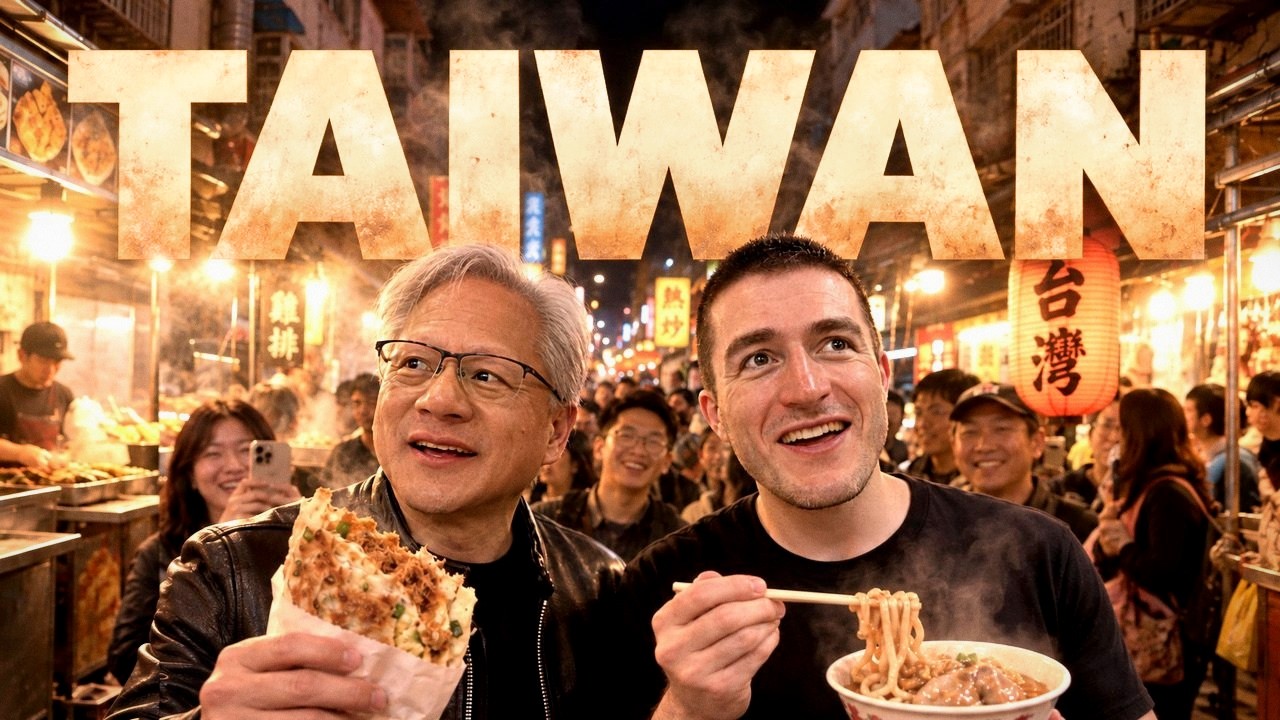
Taiwan: The Most Epic Night Market Experience w/ Jensen Huang | Lex Fridman
Summary
This discussion explores the critical role of Taiwan in the global semiconductor supply chain, noting that the island is responsible for over 90% of the world's most advanced semiconductors. The conversation delves into the economic shifts driven by AI, where the focus is moving from renting CPU cores to maximizing token generation speed. Key technological advancements discussed include 100% liquid cooling for architectures like Grace Blackwell. Furthermore, the speakers analyze the concept of the 'flywheel'—the synergy between technology leadership and wealth—as the primary driver for sustained economic and national advantage, suggesting that reindustrialization efforts in the United States are strategically linked to Taiwan's manufacturing prowess.
Key takeaways
-
Taiwan's Semiconductor Dominance
2:01
Taiwan is described as the global hub for advanced semiconductors, making it virtually impossible to replicate the industry's concentration anywhere else in the world. The history of the industry is attributed to foundational efforts by companies like Philips, UMC, and TSMC.
-
AI Economics and Compute
5:52
In the AI era, the economic model shifts from optimizing 'dollars per core' (as in previous CPU generations) to maximizing the speed of token generation, making compute capacity paramount.
-
The Flywheel Effect
18:22
Sustained global power is achieved by optimizing for a 'flywheel'—a positive feedback loop where technology leadership drives economic wealth, which in turn fuels further technology development. This is presented as a more sophisticated long-term strategy than simply hoarding physical resources.
-
Global Collaboration vs. Conflict
22:10
The speakers emphasize that global interdependence, particularly in AI stacks and hardware infrastructure, makes conflict difficult and suggests that collaboration and friendly competition are essential for global prosperity.
Technical details
-
Semiconductor Manufacturing
430s
The industry's foundation was established by key players like Philips, UMC, and TSMC. The development of the PC industry was accelerated by the open specification of IBM Compatible Chipsets, allowing companies like Michael Dell to build PCs using Taiwanese chipsets.
-
Advanced Cooling and Architecture
230s
Modern high-performance computing architectures are moving toward 100% liquid cooling, significantly improving reliability and reducing assembly time (e.g., from two hours to five minutes).
-
AI Compute and Business Models
352s
The fundamental purpose of modern AI computing is to rapidly cycle through an exchange loop to generate tokens, shifting the economic focus from core count to token throughput.
-
Supply Chain Resilience
1030s
The discussion highlighted the strategic importance of Taiwan as a partner in reindustrializing the United States, particularly in establishing world-class semiconductor manufacturing fabs.
Mentioned resources
- NVIDIA
- TSMC
- UMC
- Grace Blackwell
- CoWoS
- Perplexity
Channel & topics
Watch on YouTube · Back to latest
This independent, AI-assisted summary is provided for commentary and informational purposes. It may contain errors or omit important context. Please watch the original video for the creator's complete presentation. Video, thumbnail, and related copyrights belong to their respective owners.