Robots That Predict the Future: Dyna-2 & Physical AI — Jason Ma, Dyna Robotics
Summary
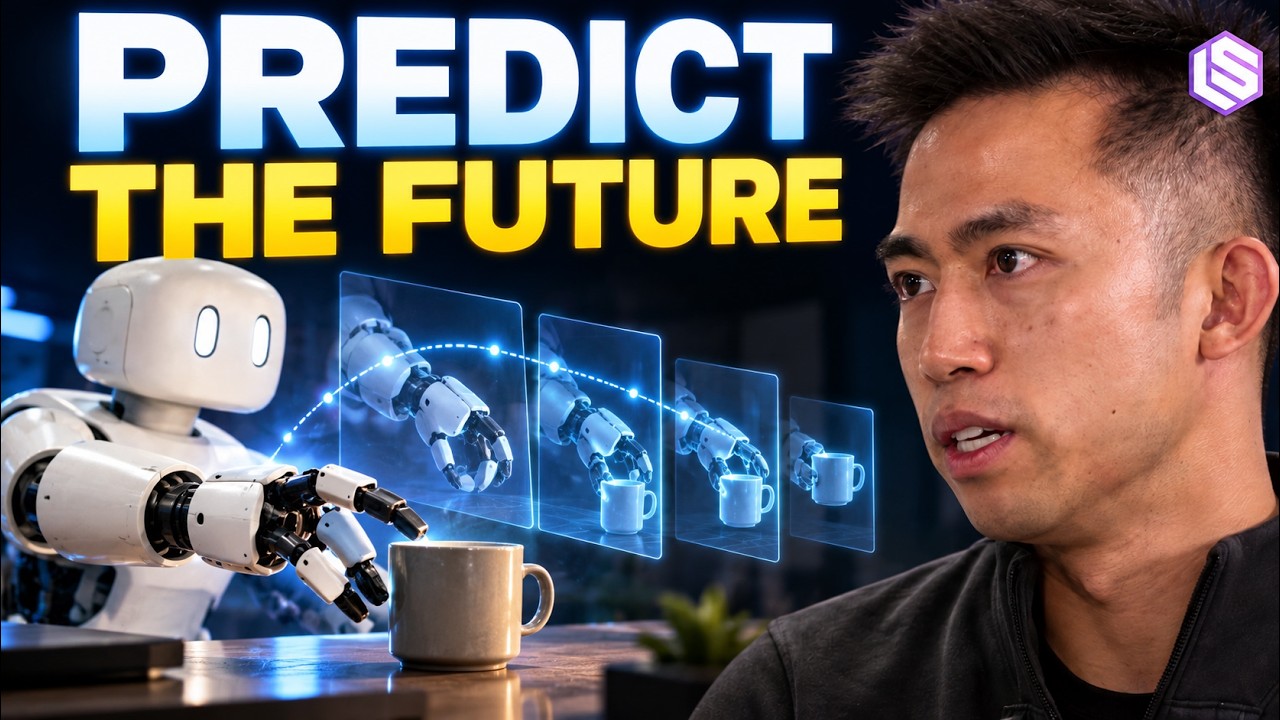
Dyna Robotics is advancing physical AI by moving beyond simple demos to reliable, general-purpose industrial deployments. The core technology is the Dyna-2 world action model, which is trained on over one million hours of human video data. This model predicts the future state of the physical world and uses that prediction to guide robot actions, allowing for high levels of dexterity and generalization. The company emphasizes that true value lies not in single-task pilots, but in deploying robots across multiple customer sites to handle complex, long-horizon workflows (e.g., full laundry cycles or restaurant service).
Key takeaways
-
World Action Models (Dyna-2)
2:00
Dyna-2 is a world action model trained on over 1 million hours of data. It predicts the future video/state of the world and uses this prediction to guide robot actions, making the robot more robust and capable of generalizing to unseen scenarios. The model architecture is based on a Diffusion Transformer, which refines the output to achieve smooth, precise, fine-grain motion required for physical execution.
-
Generalization and Data Efficiency
5:50
The system is designed to be generalist. After initial training on massive human data, the model can adapt to new tasks with minimal fine-tuning, sometimes requiring as little as 45 minutes of demonstrations (e.g., pulling drinks from a fridge). This approach is key to achieving production-level consistency across different sites.
-
Workflow Automation (Agentic Harnesses)
11:20
The value of the system is in solving long-horizon tasks or workflows, not single actions. An 'agentic harness' layer is used to wrap the world action model, enabling high-level decision-making (e.g., 'if the washer is running, I should go do X while waiting') and composing multiple skills into a single, continuous process, such as an entire laundry cycle.
-
Industry Bottlenecks
14:10
The primary bottlenecks to achieving truly general-purpose robotics are hardware limitations (e.g., durable, dextrous hands that don't overheat) and data acquisition. While egocentric human video data is crucial, the model currently lacks critical sensory inputs like touch, smell, and sound, limiting full world prediction.
Technical details
-
World Action Model Architecture
180s
The model uses a Diffusion Transformer architecture, which is effective for generating high-dimensional, precise actions. Flow Matching is utilized as an efficiency improvement over traditional diffusion steps, simplifying the training schedule while maintaining performance.
-
Input/Output Streams
210s
Inputs include video/images captured by the robot's cameras, joint encoder data (angles of the robot's joints), and language instructions. The output includes executable actions for the hardware, alongside a future video representation of the world state.
-
System Stack
750s
The system requires a full-stack approach, including custom hardware (semihumanoid form factor with wheels for stability), a dedicated inference stack to manage low latency, and the model itself. The hardware design is often tied to the model's ability to be accurately simulated.
Mentioned resources
Channel & topics
Watch on YouTube · Back to latest
This independent, AI-assisted summary is provided for commentary and informational purposes. It may contain errors or omit important context. Please watch the original video for the creator's complete presentation. Video, thumbnail, and related copyrights belong to their respective owners.