How to Ace AI Eval Interview Questions (for Engineers & PMs)
Summary
This guide outlines a structured approach for tackling AI evaluation (e-vals) assessments in job interviews. Candidates are advised to structure their artifact by focusing heavily on data analysis (50-70% of effort), detailing experiments run, summarizing results, and discussing key learnings and limitations. The core emphasis is on demonstrating resourcefulness, skepticism regarding provided data, and strong product judgment by analyzing trade-offs (e.g., complexity vs. performance) rather than simply maximizing scores.
Key takeaways
-
Structure the Evaluation Artifact
3:29
The recommended structure is: Executive Summary (brief), Data Analysis (most critical section), Experiments Run, Summary of Results, Key Learnings/Limitations, and Next Steps/Recommendations.
-
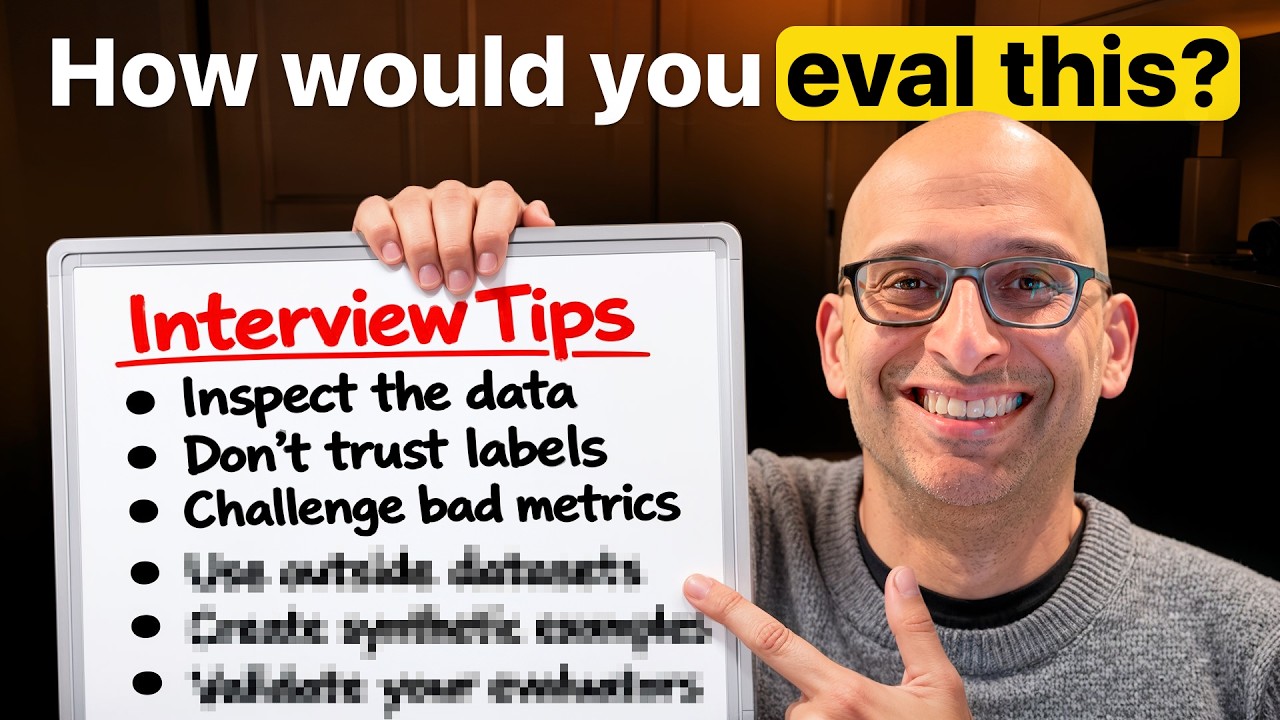
Prioritize Data Skepticism
7:15
Never assume the provided dataset is correct. Look for missing, inconsistent, or insufficient labels, and identify data noise. Solving for missing negative examples (e.g., guardrails) is often the primary challenge.
-
Showcase Resourcefulness
9:45
When data is limited, demonstrate resourcefulness by leveraging external datasets (e.g., Hugging Face) or generating synthetic data (e.g., for negative examples) to augment the provided data set.
-
Frame Experiments and Trade-offs
13:40
Present experiments in a table format, comparing different approaches (e.g., 'GPT-6 Luna with prompt only' vs. 'GPT-6 Luna with external database lookup'). Discussing trade-offs (cost, latency, complexity) and identifying overfitting (e.g., high validation score, low test score) is crucial for demonstrating judgment.
-
Address Ambiguous Metrics
If the interviewer provides a questionable metric (e.g., combining helpfulness and tone into a composite score), compute the score but also explain why you would refactor or improve the metric, thereby teaching the interviewer and avoiding a trap.
Technical details
-
Data Quality Issues
619s
Identifying inconsistent labels (e.g., species name mismatch) or insufficient label data is critical. The goal is to solve for missing examples, such as positive/negative cases for guardrails.
-
Overfitting Detection
1144s
When reviewing results, look for discrepancies between validation set scores and test set scores. A significant drop indicates overfitting, which must be discussed.
-
Evaluation Metrics
Candidates should be prepared to discuss various metrics (e.g., TPR, TNR, F1 score) and be ready to argue why a provided metric might be suboptimal.
-
Agent Improvement Techniques
820s
Methods to improve an agent include using external databases for lookup, automated prompt tuning (e.g., Jeppa), or varying the underlying LLM (e.g., comparing different versions of GPT-6 Luna).
Mentioned resources
Channel & topics
Watch on YouTube · Back to latest
This independent, AI-assisted summary is provided for commentary and informational purposes. It may contain errors or omit important context. Please watch the original video for the creator's complete presentation. Video, thumbnail, and related copyrights belong to their respective owners.