Docker, Adobe & tldraw: Where Should Your Agent Run?
Summary
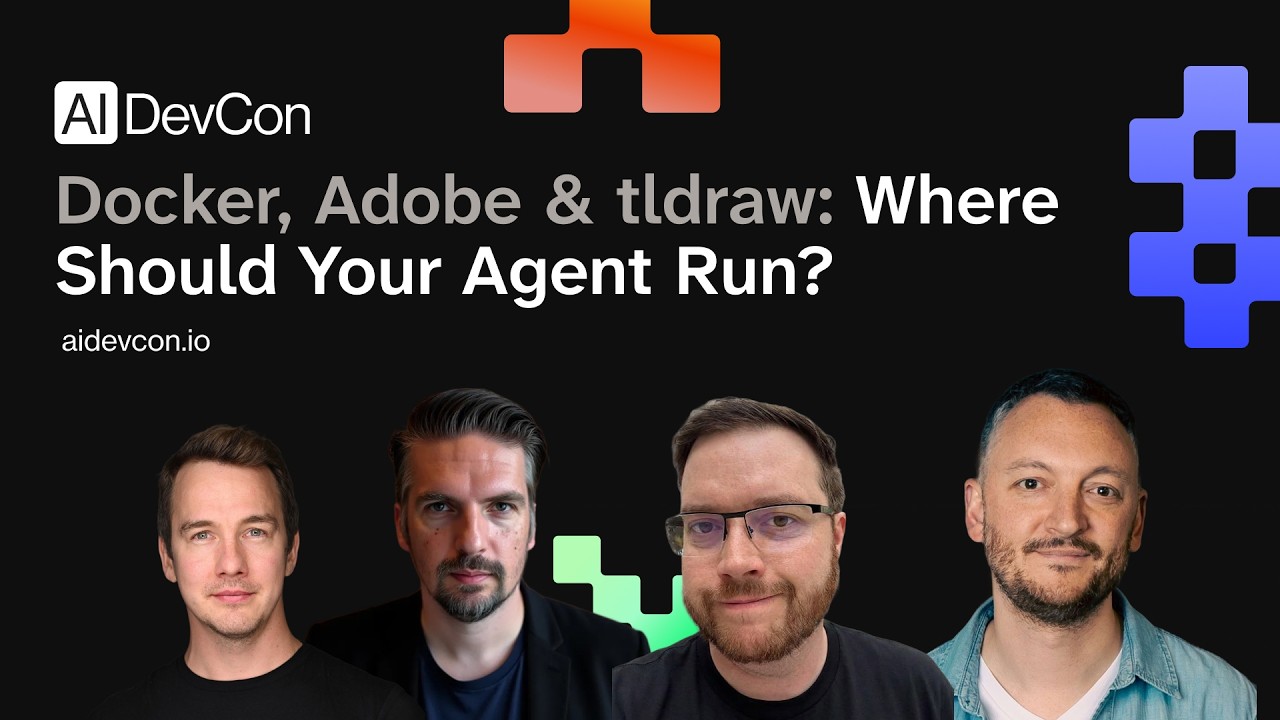
The discussion explores the critical architectural question of where AI coding agents should execute, presenting four distinct models: Docker advocates for secure microVM sandboxes; Helix ML proposes centralized, dedicated computing resources for each agent; Adobe demonstrates running the agent loop entirely within the browser tab; and tldraw visualizes agents collaborating as characters on an infinite canvas. The consensus highlights the trade-offs between isolation, centralized control, and environmental fidelity.
Key takeaways
-
MicroVMs for Agent Sandboxes
0:09
Docker recommends using micro VMs instead of traditional containers for agent sandboxes because enterprise security teams view shared kernels as an unacceptable isolation boundary.
-
Centralized Agent Infrastructure
3:03
Helix ML argues for giving every agent its own dedicated computer on centralized infrastructure (e.g., Kubernetes) to facilitate seamless handoffs of work across global time zones.
-
Browser-Native Agent Loops
7:33
Adobe demonstrated an agent that runs its entire loop and controls the browser from within the browser tab, showcasing the concept of the 'self-licking ice cream cone' (SLICC).
-
Collaborative Canvas Agents
6:13
tldraw presents agents as interactive characters on a canvas that can coordinate, plan, and execute tasks as a team, allowing for simultaneous, visible collaboration.
Technical details
-
Docker Sandboxing
143s
Docker's sandboxes use micro VMs to ensure hardware-level isolation, preventing access to the host file system and controlling all outbound requests via a networking proxy. Secrets injection mechanisms are used to provide necessary data without exposing private credentials.
-
Centralized Agent Architecture
213s
The centralized approach suggests running agents on an organization's dedicated infrastructure (e.g., Kubernetes) rather than relying on individual developer machines, enabling global team handoffs.
-
Browser-Based Agent Control
453s
Adobe's agent runs the entire agent loop within the browser, allowing it to control the displayed browser environment directly, rather than merely displaying results from a cloud runtime.
-
Agent State Visualization
603s
tldraw allows agents to exist as instances on a canvas, visualizing their state (e.g., thinking, reviewing, working) and coordinating complex tasks like playing a game as a unit.
Mentioned resources
- Docker
- Helix ML
- Adobe
- tldraw
- SLICC
Channel & topics
Watch on YouTube · Back to latest
This independent, AI-assisted summary is provided for commentary and informational purposes. It may contain errors or omit important context. Please watch the original video for the creator's complete presentation. Video, thumbnail, and related copyrights belong to their respective owners.