Dexter Horthy: Why We Stopped Trusting AI to Write the Plan
Summary
The discussion explores the shift in software development from writing code to managing 'software factories' powered by AI agents. The central thesis is that while AI agents can automate much of the implementation, the primary value shifts to defining and codifying *intent* (specs) and *preferences* (taste). The speaker argues that the process of continuous improvement—building the factory itself—is more critical than the act of reviewing individual code pull requests. Human review, therefore, evolves from checking syntax to verifying high-level architectural intent and system constraints.
Key takeaways
-
The Spec is the New Code
3:44
The industry trend is moving toward treating specifications (specs) as the primary, verifiable, and executable artifact. This approach aims to capture the full intent of a feature, which can then be compiled into code, rather than relying on the code itself as the source of truth.
-
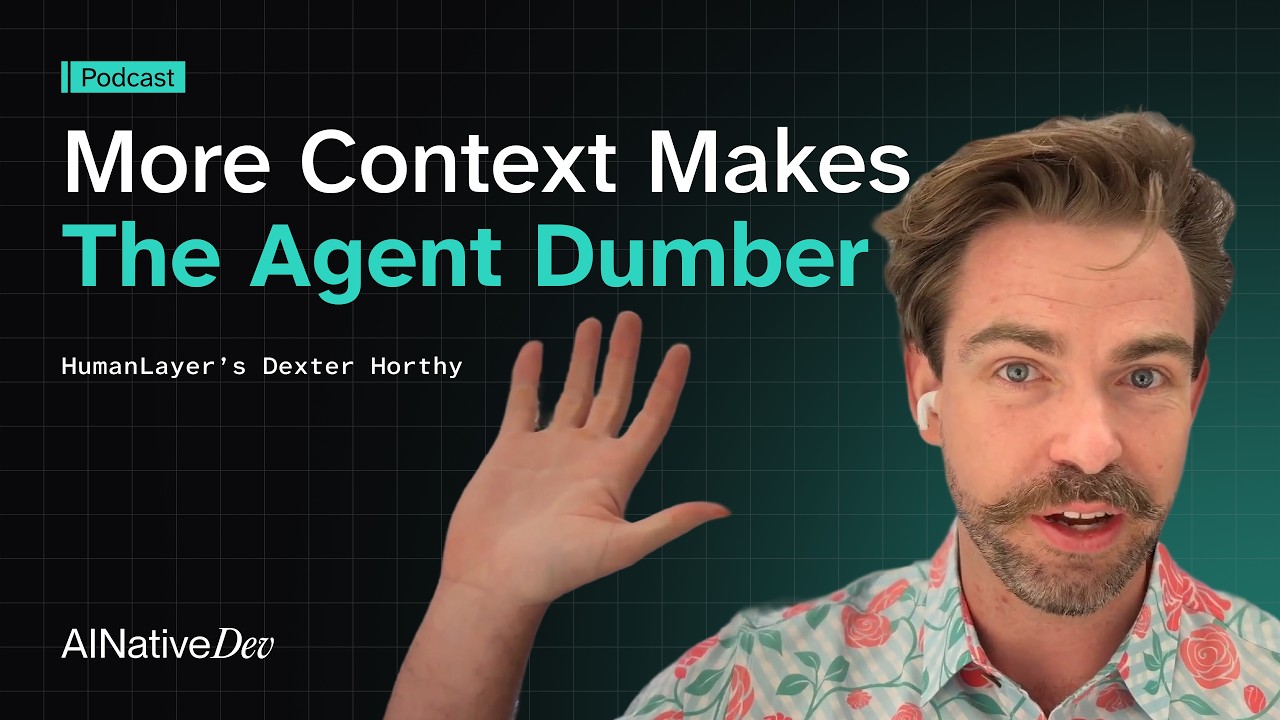
Context Engineering and the 'Dumb Zone'
10:03
Context engineering is crucial for effective agentic development. Early models exhibited a 'dumb zone' where performance degraded significantly when the context window exceeded a certain token count (e.g., 100,000 tokens), emphasizing the need for intentional context management.
-
The Value of the Software Factory
28:23
A 'software factory' is a system that automates the entire development lifecycle (planning, building, reviewing, rolling out). The goal is to shift focus from fixing individual bugs to continuously improving the factory's processes and skills, thereby increasing overall velocity.
-
The Persistence of Human Review
53:52
While AI is powerful, the speaker asserts that there will always be 'alpha in reviewing something.' Human review will shift from checking code correctness to verifying high-level architectural decisions, business logic, and unique organizational 'taste' that models cannot inherently replicate.
Technical details
-
Context Window Limitations
603s
The concept of the 'dumb zone' describes a performance dip in LLMs when the input context exceeds a certain threshold (e.g., 100,000 tokens in early testing), necessitating careful context engineering.
-
Agentic Development Tools
1132s
Tools and concepts mentioned include the `Claude CLI` (described as a 'battleship' with many flags) and the use of specialized harnesses (like the code search harness for Jeff) to manage context and tool calls.
-
System Architecture and Code Quality
2815s
The discussion highlights the risk of 'slop code' (unmaintainable code) and the need for robust architectural patterns, such as using a real-time sink database for directional data flow, rather than relying on complex, monolithic systems.
-
Development Process Improvement
2400s
The concept of 'back pressure' is introduced as a mechanism to give models structured feedback on their output, allowing them to self-correct and improve without constant human intervention.
Mentioned resources
- HumanLayer
- Tessl
- Claude CLI
- Slop Code Bench
Channel & topics
Watch on YouTube · Back to latest
This independent, AI-assisted summary is provided for commentary and informational purposes. It may contain errors or omit important context. Please watch the original video for the creator's complete presentation. Video, thumbnail, and related copyrights belong to their respective owners.