Build A Reasoning Model Scratch 3: The Verifier for Evaluation and RL with Verifiable Rewards
Summary
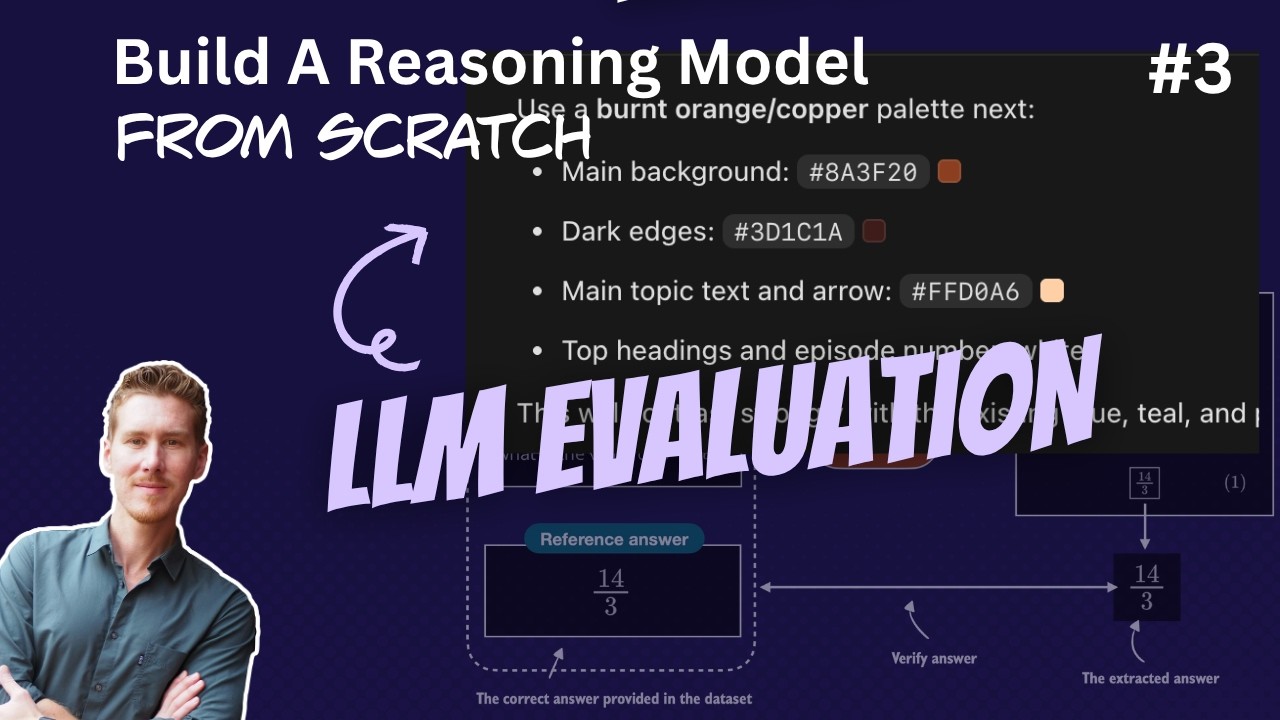
This video details the implementation of a robust verifier pipeline for evaluating Large Language Models (LLMs) on mathematical benchmarks, specifically using the MATH-500 dataset. The verifier is crucial for establishing a baseline performance metric, which will later be used in Reinforcement Learning with Verifiable Rewards (RLVR) training. The process involves eight key steps: generating text, extracting the final answer (ideally from a boxed format), normalizing the answer to a canonical form, mathematically verifying its equivalence to a ground truth using `sympy`, and finally grading the answer to compute overall model accuracy.
Key takeaways
-
LLM Evaluation Methodologies
2:01
Model evaluation can be categorized into Multiple Choice, Verifier-based, Leaderboard-based, and LLM Judge methods. The verifier approach is preferred here because it provides an objective evaluation with a hard ground truth answer, which is necessary for RLVR training.
-
The Verifier Pipeline
19:13
The evaluation pipeline is complex, requiring steps to extract the final answer, normalize the format (e.g., removing LaTeX fluff), verify mathematical equivalence, and grade the result. This robustness is critical for reliable benchmarking.
-
Model Performance Comparison
27:13
The base model's accuracy (e.g., 15.6% on MATH-500) is significantly lower than the reasoning model's accuracy (e.g., 50.8%). This highlights the value of specialized reasoning techniques and training.
-
Reproducibility Caveats
20:15
Model evaluation results can vary based on the computing device (CPU, MPS, CUDA) and due to floating-point math, necessitating running evaluations multiple times and averaging the results for robustness.
Technical details
-
Dependencies and Setup
1343s
The pipeline relies on `torch` (for tensor operations), the `reasoning-from-scratch` package (for model loading/text generation), and `sympy` (a symbolic math library used for verifying mathematical equivalence).
-
Answer Extraction and Normalization
3400s
The process requires robust code to extract the final answer, typically assuming it is enclosed in a boxed format. The extracted answer must then be normalized (e.g., replacing LaTeX formatting, stripping special tokens) to achieve a canonical form for comparison.
-
Mathematical Verification
4656s
Mathematical equivalence is checked using `sympy`'s parsing capabilities. The verifier must handle complex scenarios, such as comparing fractions in different forms (e.g., 28/6 vs. 4/3) and managing multi-part answers.
-
Evaluation Dataset
The evaluation is performed on the MATH-500 dataset, a popular benchmark of high school math problems, which provides the problem statement and the ground truth answer.
-
RLVR Workflow
720s
The verifier is designed to calculate verifiable rewards (e.g., 1 for correct, 0 for incorrect) by comparing the model's final answer to the ground truth, which is essential for Reinforcement Learning with Verifiable Rewards (RLVR).
Mentioned resources
Channel & topics
Watch on YouTube · Back to latest
This independent, AI-assisted summary is provided for commentary and informational purposes. It may contain errors or omit important context. Please watch the original video for the creator's complete presentation. Video, thumbnail, and related copyrights belong to their respective owners.