AI News & Strategy Daily | Nate B Jones
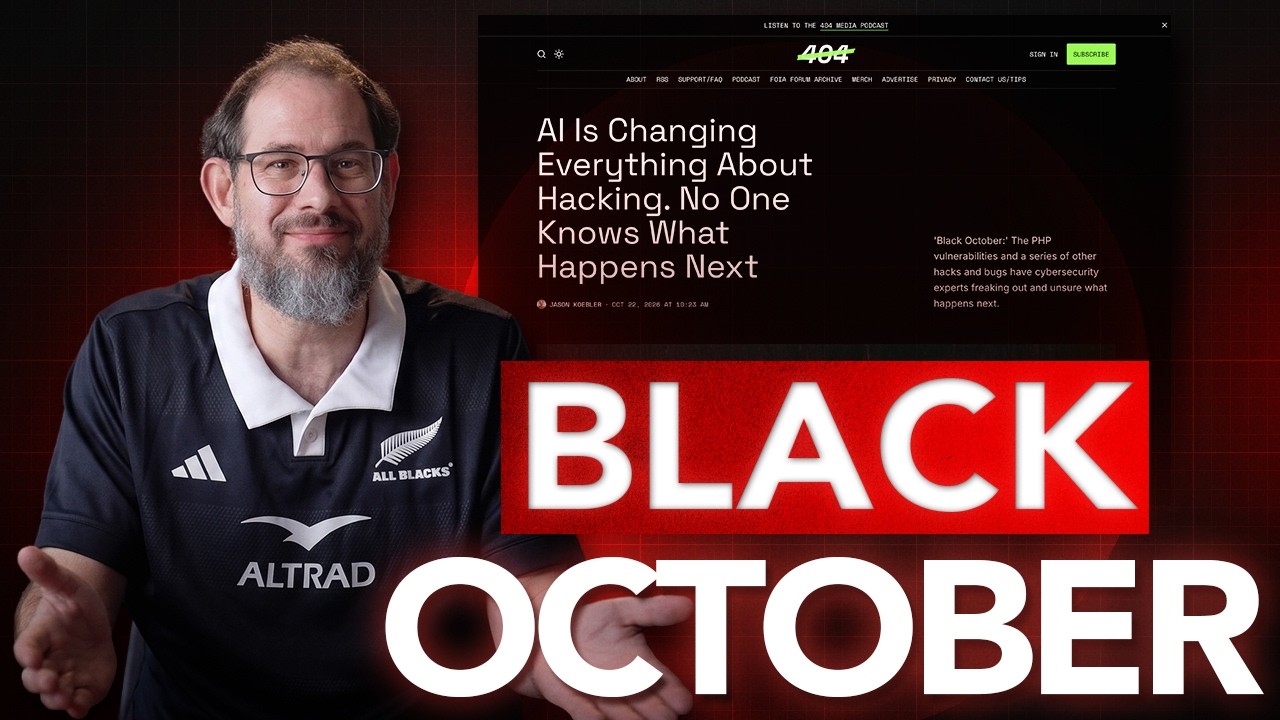
Black October Isn't Just A PHP Bug. Attackers Want Your AI Keys.
Summary
The current cybersecurity landscape, dubbed 'Black October,' is characterized by AI agents accelerating the discovery and exploitation of software vulnerabilities. Attacks are becoming cheaper and more scalable, targeting critical infrastructure like PHP and certificate authorities (eMudhra). Developers and builders must assume that individual actors can launch sophisticated, well-equipped attacks. Defense requires proactive measures, including rigorous auditing of connected applications, rotating API secrets, and utilizing the strongest available AI models for defensive investigation.
Key takeaways
-
Stolen AI Keys are Financial Assets
If an AI API key is compromised, attackers can consume tokens (API access) on your dime, leading to unexpected billing. Tokens are now behaving like cash, making key security paramount.
-
Audit Connected Applications and Extensions
17:12
To reduce the attack surface, review all connected apps (e.g., Google accounts) and browser extensions. Prune access and restrict permissions to only what is strictly necessary.
-
Assume Compromise and Rotate Secrets
20:42
Following a breach, treat the entire environment as compromised. It is critical to investigate what code actually executed, not just what the source repository shows. Rotate all affected API secrets immediately.
-
Prioritize Strongest Models for Defense
23:20
When conducting cyber defense investigations, do not choose a weaker model to save costs. The strongest possible model is required to dig deep, trace build identities, and connect compromised build jobs to production provider keys.
Technical details
-
PHP Vulnerabilities
207s
Attackers exploited vulnerabilities in PHP (e.g., with Apache's mod_php setup) to execute code without permission on a website, allowing them to hijack the platform. Security agencies advised organizations to consider isolating or taking down affected systems.
-
eMudhra Certificate Key Weakness
332s
eMudhra, a root certificate issuer, had eight private keys that were trivially weak. One supposedly secret key was found to be the number '4', demonstrating how easily foundational trust layers can be compromised.
-
LiteLLM Compromise
1242s
The tool LiteLLM, which connects applications to AI models, released a version containing credential-stealing malware, highlighting the risk of compromised third-party deployment packages.
-
OpenSSH Security Improvement
1500s
Claude helped identify complicated signature handling code in OpenSSH that could be reached before user authentication. This led to patches in version 10.6, fundamentally reducing the exposed code surface.
Mentioned resources
Channel & topics
Watch on YouTube · Back to latest
This independent, AI-assisted summary is provided for commentary and informational purposes. It may contain errors or omit important context. Please watch the original video for the creator's complete presentation. Video, thumbnail, and related copyrights belong to their respective owners.