Ask the Experts: Nemotron 3.5 Super VL | Nemotron Labs
Summary
NVIDIA introduced Nemotron 3.5 Super VL, a multimodal open model designed for high-volume, specialized autonomous agent tasks. The model processes both text and images and is optimized for efficiency, boasting 120 billion total parameters while maintaining performance comparable to much larger models. Key architectural advancements include the integration of vision capabilities and sophisticated training techniques like distillation and mid-training, allowing for superior performance in agentic and vision-language workloads. The model is optimized for deployment on hardware like DGX Spark and utilizes NVFP4 quantization for efficient local operation.
Key takeaways
-
Nemotron 3.5 Super VL Capabilities
2:00
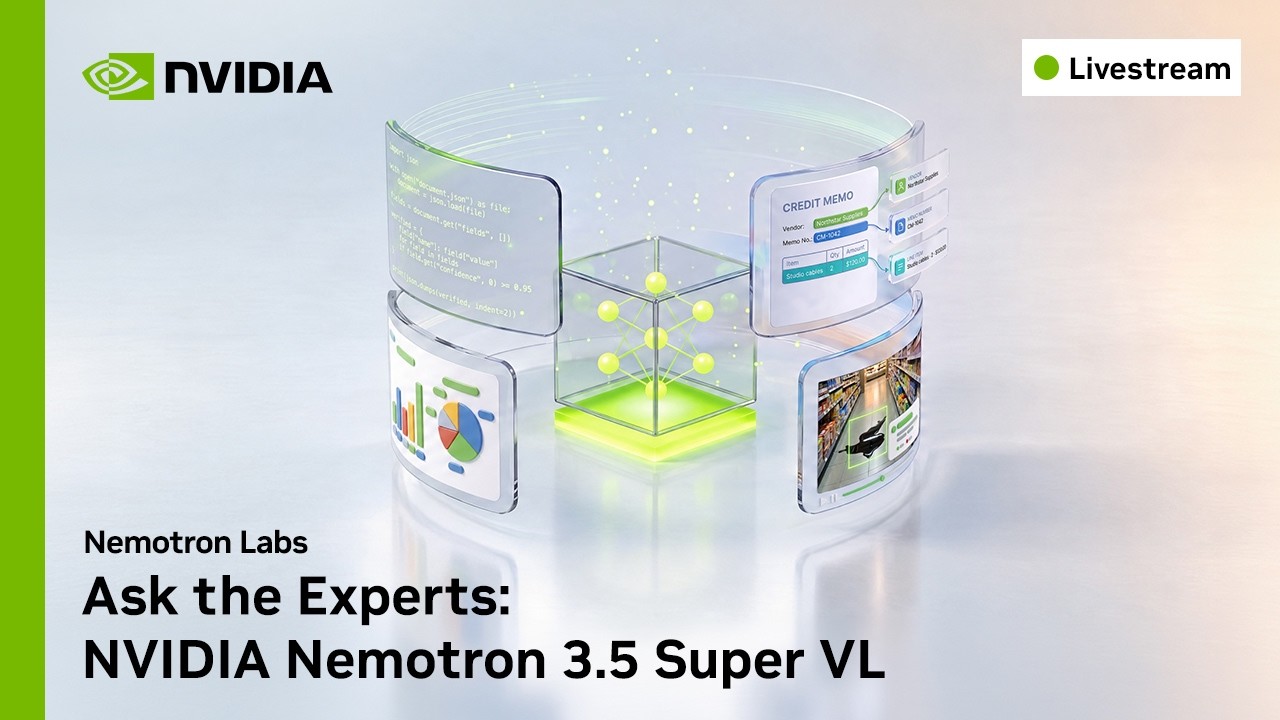
The model is a multimodal system capable of processing and reasoning across text and images, making it suitable for agentic and vision-language workloads. It is designed to be highly flexible, performing well in areas like document understanding, chart analysis, and visual reasoning.
-
Efficiency and Scale
17:10
Nemotron 3.5 Super VL has 120 billion total parameters (with 12 billion active parameters), achieving performance comparable to much larger models (e.g., the 550 billion parameter Ultra model) while maintaining a significantly smaller footprint, emphasizing efficiency over sheer size.
-
Deployment and Optimization
5:10
The model can be run locally on hardware like DGX Spark (which has 128 GB of GPU memory) or other consumer devices with sufficient unified memory (e.g., Mac devices with >128 GB). Optimization is achieved through NVFP4 quantization, allowing for deployment flexibility.
Technical details
-
Multimodal Architecture (VL)
420s
The vision capability was added later in the development cycle. The process involved adding a vision model and a vision projection layer alongside the LLM, followed by specialized vision pre-training to integrate the modalities.
-
Training Methodology (3 to 3.5)
1300s
The upgrade from Super 3 to 3.5 involved multiple stages: 1) Distillation from the Ultra model during pre-training, 2) A newly added mid-training stage (the first for Nemotron models), and 3) Scaling up the quality and quantity of Supervised Fine-Tuning (SFT) traces. High-quality data filtering was critical to maintain performance despite a smaller token count compared to Ultra.
-
Agentic and RL Training
1400s
The model benefits from extensive Reinforcement Learning (RL) with sandboxes and execution. For agentic tasks, the team scaled up the RL process, focusing on 'long horizon RL' for complex tasks like search and coding, which is crucial for robust agent behavior.
-
Mixture of Experts (MoE) Balance
1800s
The experts are not domain-specific but are token-granular. Maintaining 'expert load balancing' during training (SFT, pre-training, mid-training) is critical. Unbalanced experts can lead to instability and 'train-inference mismatch' during RL, making balanced training essential for robust performance.
-
Inference Modes and Latency
2400s
The model offers three reasoning modes (Off, Medium, High). For optimal usability, the recommendation is to start with 'Reasoning Off' for day-to-day tasks, escalating to Medium, and finally High if accuracy is insufficient. Training aims for calibration, ensuring the model reasons appropriately without excessive token usage.
Mentioned resources
- GitHub (nvidia-nemotron)
- Technical Report
- Learning Paths
Channel & topics
Watch on YouTube · Back to latest
This independent, AI-assisted summary is provided for commentary and informational purposes. It may contain errors or omit important context. Please watch the original video for the creator's complete presentation. Video, thumbnail, and related copyrights belong to their respective owners.