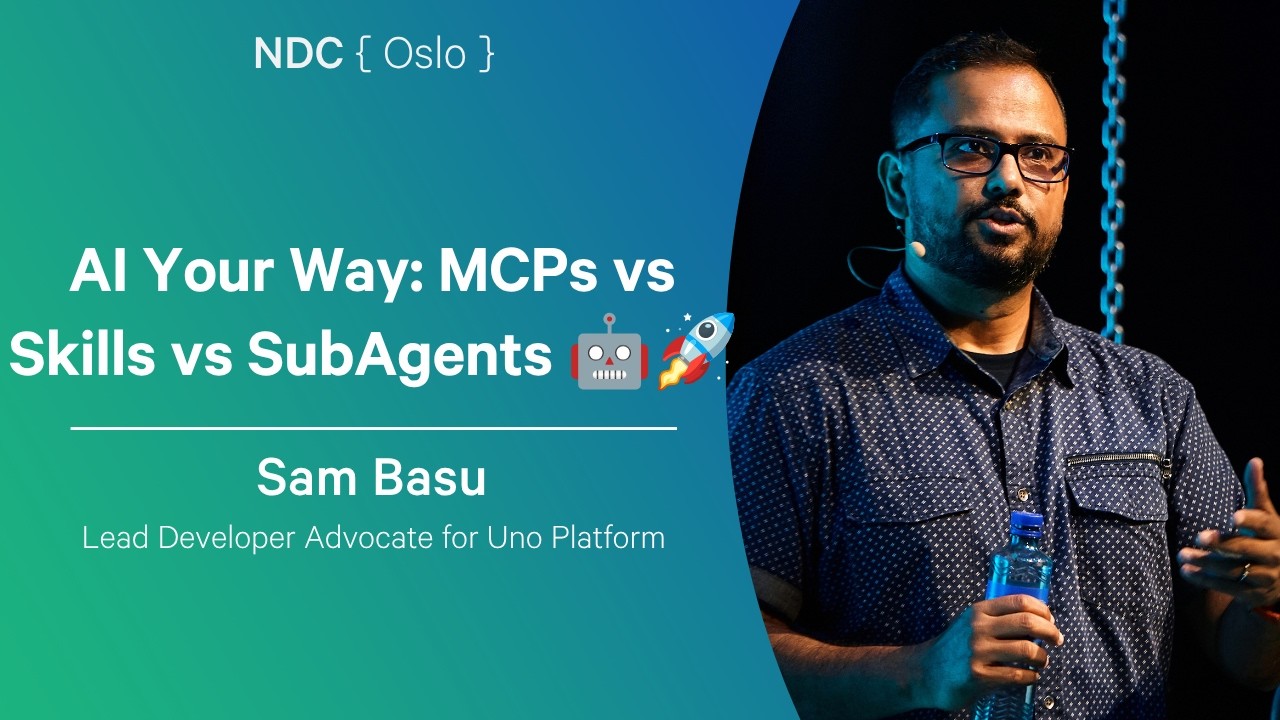
AI Your Way: MCPs vs Skills vs SubAgents 🤖🚀 - Sam Basu - NDC Oslo 2026
Summary
The talk outlines how to move beyond basic AI code generation by implementing robust context and guardrails. The Model Context Protocol (MCP) is presented as a standardized, foundational method for connecting AI Agents to private data sources, APIs, and internal documentation. By leveraging MCPs, Skills, and SubAgents, developers can ensure AI workflows are grounded, secure (supporting OAuth 2.1), and highly productive, even when running entirely locally or within enterprise firewalls.
Key takeaways
-
Context is Critical for AI Reliability
3:40
AI agents are powerful but prone to generic outputs, hallucinations, and overcorrections without proper guardrails. Developers must ground agents using techniques like Retrieval Augmented Generation (RAG) and by exposing internal APIs and documentation via MCPs.
-
MCP Standardizes Agent Tooling
21:40
The Model Context Protocol (MCP) provides a standardized way to expose enterprise resources (APIs, databases, docs) as callable tools to AI agents. This is foundational and not tied to a specific technology stack.
-
Layering AI Components for Maturity
4:00
AI workflows benefit from a layered approach: Agents (the orchestrator), Skills (prescriptive, reusable guidance/recipes), and SubAgents (specialized, delegated tasks). This structure allows developers to manage complexity and maintain control.
-
Enabling Local and Secure AI
46:40
For privacy-sensitive environments, AI agents and models can run entirely local (e.g., using Olama with local models like Gemma 4). MCPs support enterprise security by adhering to the OAuth 2.1 standard.
Technical details
-
Model Context Protocol (MCP)
1300s
MCP is a standard for exposing tools and services to AI agents. The architecture involves a Host (e.g., VS Code), a Client (the agent/harness), and a Server (the API/DB). Communication is simple JSON over HTTP/SSE. MCP tools can expose not only JSON data but also rich UI/HTML outputs.
-
Agentic Workflow Components
240s
Agents are the main workflow orchestrators. Skills provide fixed, prescriptive guidance (like a recipe card). SubAgents delegate specific, well-defined tasks to the main agent, preventing the agent from becoming overwhelmed.
-
Cross-Platform Development and AI
2000s
The Uno Platform demonstrates how a single shared codebase (.NET) can be used to build cross-platform apps (iOS, Android, WebAssembly, Desktop). MCPs and Skills are integrated to allow agents to interact with the app's internal logic and documentation.
-
Security and Deployment
2300s
MCPs support OAuth 2.1, allowing for secure, authenticated access to enterprise tools. Local deployment is possible using dedicated hardware and tools like Olama, enabling agents to run behind corporate firewalls.
Mentioned resources
- Model Context Protocol (MCP)
- Uno Platform
- Ollama
Channel & topics
Watch on YouTube · Back to latest
This independent, AI-assisted summary is provided for commentary and informational purposes. It may contain errors or omit important context. Please watch the original video for the creator's complete presentation. Video, thumbnail, and related copyrights belong to their respective owners.