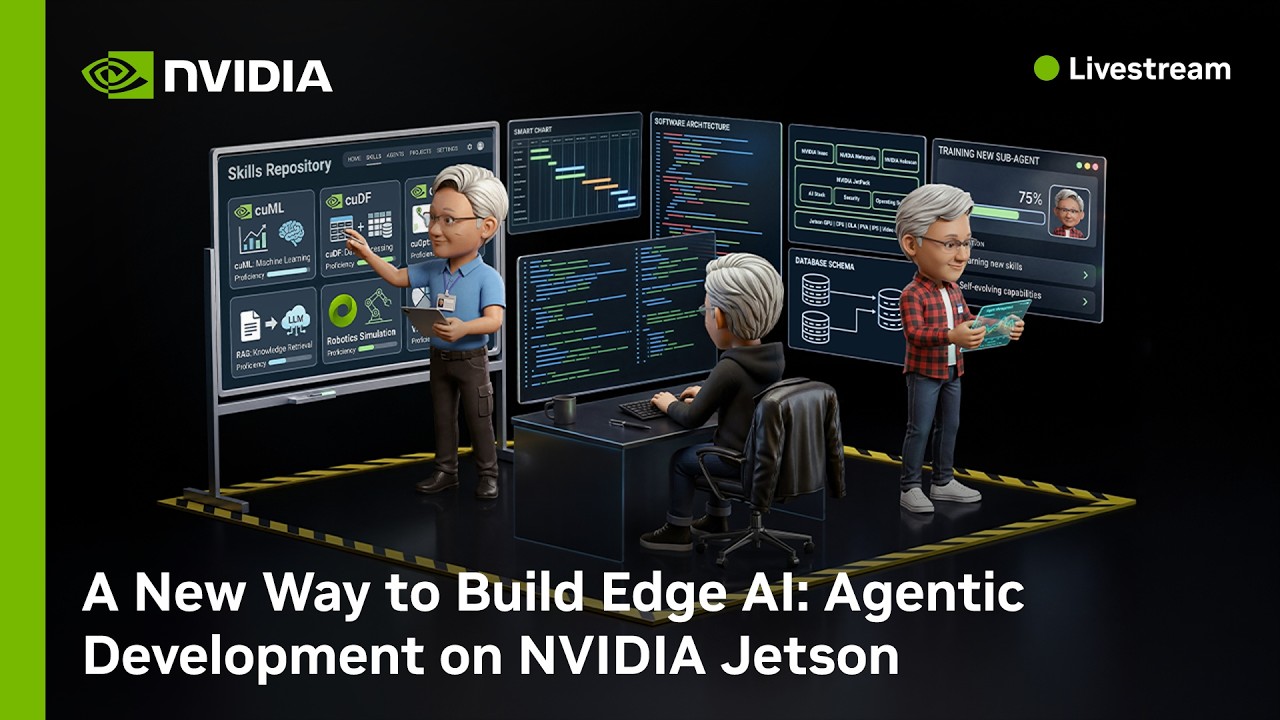
A New Way to Build Edge AI: Agentic Development on NVIDIA Jetson
Summary
Agentic development significantly accelerates the process of building and optimizing Edge AI applications on NVIDIA Jetson devices. By integrating coding agents (like Codex or Claude Code) with specialized Jetson skills, developers can automate complex tasks such as environment inspection, software configuration, and AI pipeline construction, drastically reducing setup time and iteration cycles. The process allows developers to move from a natural language prompt to a working, optimized, and deployable edge AI build.
Key takeaways
-
Accelerated Development Cycle
2:30
Coding agents, paired with Jetson skills, automate the complex coordination required for edge AI, including hardware inspection, software environment setup, and inference pipeline construction, minimizing manual guesswork and troubleshooting.
-
Jetson Skills for Deep Integration
4:40
Two types of skills are available: Device Skills (run on the booted Jetson) for diagnosing memory use, GPU activity, and benchmarking inference; and BSP Skills (run on a host workstation) for customizing and flashing the Board Support Package.
-
Vision Language Models (VLM) on Edge
11:30
Models like NVIDIA Cosmos 3 Edge (a 4B parameter model) can run on small devices like the Jetson Orin Nano, enabling complex tasks such as simultaneous video description and object detection across multiple camera streams.
-
Cloud-to-Edge Workflow
17:30
The development process leverages a coding agent running in the cloud (e.g., Codex) while the Jetson acts as the local harness. This allows the agent to virtually access the device's hardware and resources for development, ensuring the final deployed application is self-sustained and internet-independent.
Technical details
-
Agentic Development Workflow
180s
The workflow involves a developer providing a prompt to a coding agent (e.g., Codex, Claude Code, Cursor). The agent then inspects files, runs tools, and accesses specialized 'skills' (like Jetson skills) to guide the process, making changes and iterating until the application is built and deployed on the Jetson.
-
Jetson Device Skills
280s
These skills help the agent understand the live system, including memory use, GPU activity, and available runtimes. They are useful for diagnosing problems, setting up models, and benchmarking inference.
-
Jetson BSP Skills
310s
These skills run on a host workstation and enable customization and flashing of the Board Support Package (BSP), which is necessary for configuring custom carrier boards before the device boots.
-
Model Optimization and Deployment
1300s
The process involves using tools like TRT Edge LLM and optimization techniques (e.g., CUTLASS) to quantize large models (like Cosmos 3) into small, performant versions (e.g., 4B parameter models) suitable for low-resource devices like the Orin Nano.
Mentioned resources
- NVIDIA Jetson
- Codex / Claude Code / Cursor
- NVIDIA Cosmos 3 Edge
- Jetson Skills (Device & BSP)
- Jetson AI Lab
Channel & topics
Watch on YouTube · Back to latest
This independent, AI-assisted summary is provided for commentary and informational purposes. It may contain errors or omit important context. Please watch the original video for the creator's complete presentation. Video, thumbnail, and related copyrights belong to their respective owners.