8 Claude Code skills I use for building better AI evals
Summary
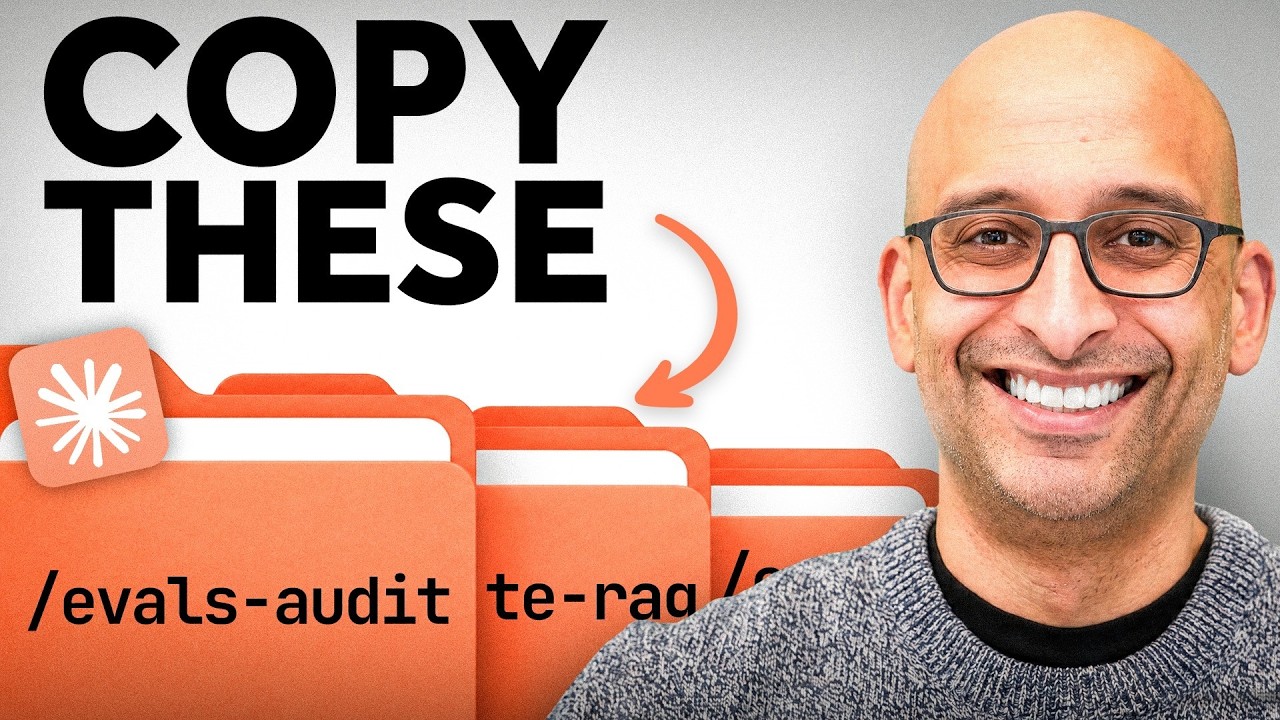
This technical deep dive introduces eight specialized Claude Code skills designed to improve the robustness of AI product evaluations (AI Evals). The core message is that teams must analyze real product failures before designing evaluation metrics. The two most critical skills are 'Error Discovery,' which guides the process of finding failure modes by reviewing data traces, and 'Eval Audit,' which systematically checks the entire evaluation setup against common industry mistakes.
Key takeaways
-
Prioritize Failure Analysis Over Planning
The biggest mistake in AI product development is writing evaluation plans before analyzing actual failures observed in the product. The speaker recommends starting with the Error Discovery and Eval Audit skills.
Technical details
-
Error Discovery Skill
0s
This skill guides the agent through multiple phases to find failure modes: 1) Data understanding (parsing structure and identifying dimensions of variation). 2) Annotation Interface Design (using principles like Gestalt). 3) Building the review interface. It intelligently samples data, prioritizing diversity (breadth) over frequency, and utilizes an interactive review loop that updates sampling as new errors are found.
-
Eval Audit Skill
7s
This skill performs diagnostic checks on the evaluation pipeline to prevent common mistakes. Checks include ensuring error analysis was performed, confirming failure categories are observed in data, mandating binary pass/fail metrics (avoiding Likert scales), validating LLM judges against human labels, and checking for proper data splitting to prevent overfitting.
-
LLM Judge Validation
8s
To ensure an LLM judge is reliable, the Eval Audit skill mandates checking it against human labels. It also emphasizes proper data hygiene and splitting to prevent the judge from 'cheating' during evaluation.
-
Synthetic Data Generation
10s
The 'Generate Synthetic Data' skill is useful for pre-product stress testing when real user data is unavailable, helping to maximize the diversity of the synthetic data.
Mentioned resources
Channel & topics
Watch on YouTube · Back to latest
This independent, AI-assisted summary is provided for commentary and informational purposes. It may contain errors or omit important context. Please watch the original video for the creator's complete presentation. Video, thumbnail, and related copyrights belong to their respective owners.