I Monitored Crime Audio. Voice Agents Scare Me More. — Sumanyu Sharma, Hamming AI
The presentation compares the monitoring of decentralized, hyper-local crime data (Hamming's initial work) with the rapidly scaling, centralized risks of conversational voice agents. While voice AI is advancing rapidly, reliability remains the primary blocker for large-scale deployment. The speaker emphasizes that because voice agents are centralized, a single prompt or architectural change can have a massive 'blast radius.' He advocates for a continuous monitoring loop—including deep manual analysis, frequency/severity prioritization, and adversarial red teaming—to mitigate risks like unauthorized actions, incorrect information provision, and the leakage of PHI/PII.
Key takeaways
-
Voice Agents vs. Crime Monitoring
7:12
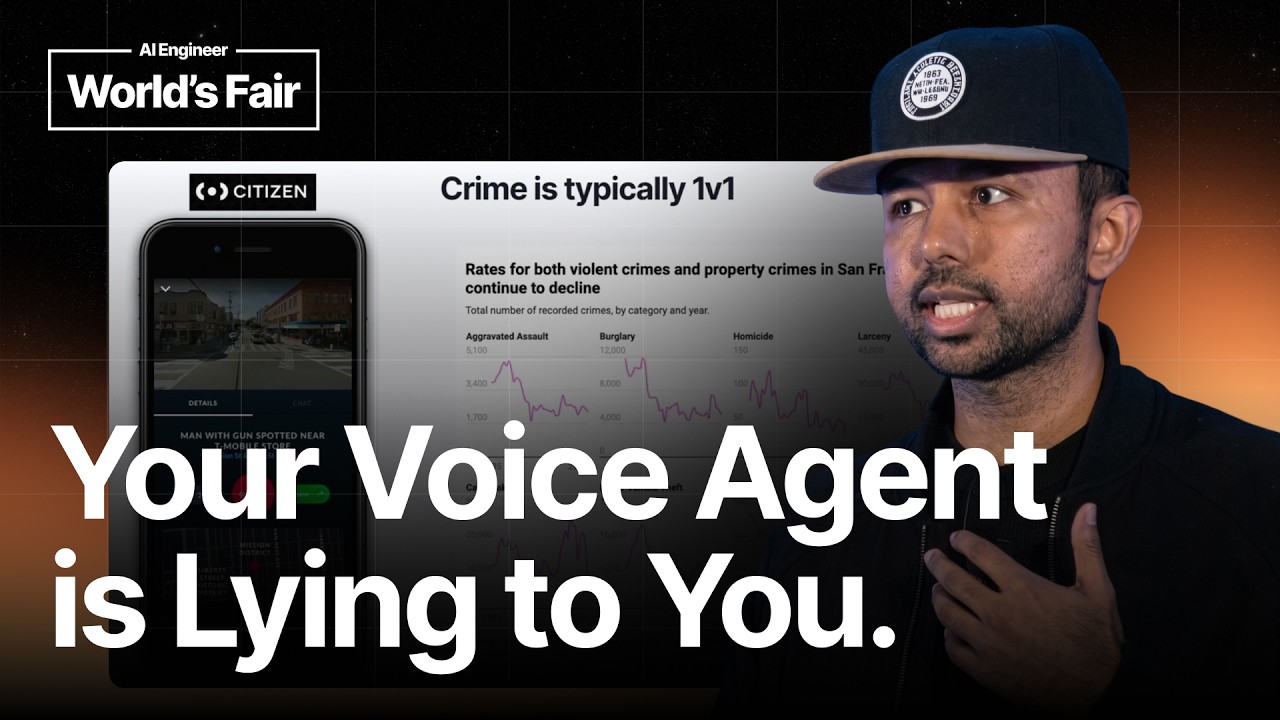
Crime incidents are generally hyper-local and decreasing, while voice agent usage is centralized and rapidly increasing, potentially handling a trillion calls annually. This centralization means a single failure point can impact millions of users.
-
The Scale of Risk
8:43
If a 1% error rate is assumed across annual calls, this equates to 10 billion potential bad interactions. In practice, monitoring 10,000 agents shows an error rate closer to 10%, manifesting as skipping eligibility checks or providing incorrect information.
-
The Continuous Improvement Loop
11:44
Fixing voice agent reliability requires a structured loop: Identify problems, prioritize by frequency and severity, understand the fix, execute the change, verify it hasn't caused regressions, and continue monitoring in production.